
When selecting an industrial valve, the design may look simple, but choosing the wrong type can lead to material blockages, leakage, unnecessary maintenance, and operational problems. This is particularly important when comparing slide gate valves and knife gate valves, as both use a sliding gate mechanism but are designed for different operating conditions.
The Slide Gate Valve vs Knife Gate Valve comparison is especially relevant for engineers, plant managers, maintenance teams, and procurement professionals working in cement, wastewater, mining, paper and pulp, chemical, and power industries.
Although these valves may appear similar, their applications, sealing arrangements, installation methods, and material-handling capabilities can differ significantly. A slide gate valve is commonly used to discharge dry bulk materials from hoppers and silos, whereas a knife gate valve is generally selected for isolation in pipelines carrying liquids, slurry, wastewater, or other media containing suspended solids.
For buyers evaluating a Slide Gate Valve Manufacturer in India, understanding these differences is important before requesting a quotation or finalising a product specification. The same applies when selecting a knife gate valve for demanding process applications.
In this guide, we explain how both valves work, where they are used, how they differ, and what to consider when choosing a suitable industrial valve for your application.
What Is a Slide Gate Valve?
A slide gate valve is designed to control or stop the movement of bulk materials through an opening. It consists of a valve body or frame, a sliding gate plate, guides, and an operating mechanism.
When the gate moves away from the opening, material can pass through. Moving the gate back across the opening restricts or stops the discharge.
These valves are commonly installed beneath hoppers, silos, bins, chutes, and storage vessels where materials need to be released into another part of a production system.
Common applications of slide gate valves
Slide gate valves are widely used in industries that handle dry or semi-dry materials, including:
- Cement manufacturing and material handling
- Sugar processing plants
- Chemical and fertiliser industries
- Power plants and ash handling systems
- Grain and bulk food processing
- Powder and granule handling
- Pneumatic conveying systems
- Industrial silos and hoppers
Depending on the application, slide gate valves may have square, rectangular, or round openings. Their dimensions and construction are selected according to the material being handled and the available installation space.
For example, a cement plant may use a slide gate valve beneath a storage silo to control the discharge of powdered material. A suitable valve design helps integrate the discharge point with the downstream conveyor or processing equipment.
When evaluating a Slide Gate Valve Manufacturer in Indore, buyers should check whether the manufacturer can provide the required opening dimensions, construction materials, operating mechanism, and design for the intended application.
What Is a Knife Gate Valve?
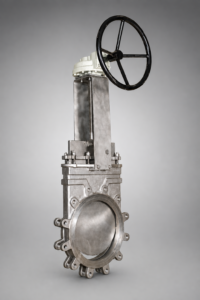
A knife gate valve is an industrial valve designed primarily for on-off isolation in applications where the process medium may contain suspended solids, fibres, sludge, or slurry.
Its main component is a blade-like gate that moves through the valve body to open or close the flow passage. The gate design can help it move through certain solids-containing media that may be difficult for other valve designs to handle.
Knife gate valves are commonly used in water and wastewater treatment, mining, paper and pulp, and other process industries. However, not every knife gate valve is suitable for every slurry, pressure, or temperature. The valve’s rated operating conditions must always be checked.
Common applications of knife gate valves
- Water and wastewater treatment
- Sludge and slurry handling
- Paper and pulp processing
- Mining and mineral processing
- Cement and power industries
- Biogas plants
- Industrial drainage systems
- Process pipelines carrying compatible solids-containing media
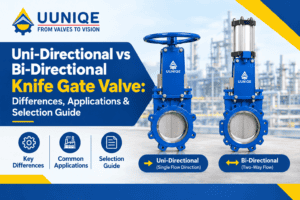
Knife gate valves are available in different configurations, including uni-directional and bi-directional designs. A uni-directional valve is designed primarily to seal against pressure from a specified direction, while a bi-directional design is intended to provide shut-off from either direction within its rated limits.
For industries that require reliable isolation, choosing a Knife Gate Valve Manufacturer in India with suitable product configurations and technical knowledge can help buyers match the valve to actual operating conditions.
Slide Gate Valve vs Knife Gate Valve: Key Differences
The main difference between these two valves is their intended application. Both use a sliding gate, but the gate design, body construction, sealing arrangement, and installation requirements can vary.
| Comparison factor | Slide Gate Valve | Knife Gate Valve |
| Main purpose | Control or isolate bulk material discharge | Isolate flow in process systems |
| Typical medium | Powders, granules, and dry bulk solids | Slurry, wastewater, pulp, and compatible liquids containing solids |
| Gate design | Sliding plate | Blade-like gate |
| Common installation | Hoppers, silos, bins, and chutes | Pipelines and process systems |
| Typical industries | Cement, sugar, grain, and bulk chemicals | Wastewater, mining, paper and pulp, and process industries |
| Port design | Square, rectangular, or round configurations are common | Commonly designed for pipeline installation |
| Operating mechanism | Manual or powered, depending on the design | Manual or powered, depending on the design |
| Sealing requirements | Depend on material and discharge requirements | Depend on seat design, pressure direction, and process conditions |
| Key selection factor | Material flow characteristics and outlet dimensions | Medium, pressure, solids content, and required shut-off performance |
These differences provide a useful starting point, but the manufacturer’s technical specifications should always guide the final selection.
How Do These Valves Work?
Working principle of a slide gate valve
A slide gate valve works by moving a plate across a material discharge opening.
When the valve is open, the gate moves away from the outlet, allowing material to pass through. When it closes, the plate covers the opening and restricts the discharge.
The mechanism can be operated manually or through an actuator. In automated production facilities, powered operation may be integrated with sensors, control panels, or other process equipment.
The performance of a slide gate valve depends on the material’s particle size, moisture content, flowability, and tendency to bridge or accumulate around the opening. These factors should be considered during valve selection.
Working principle of a knife gate valve
A knife gate valve uses a blade-like gate that moves into or out of the flow path.
In the open position, the gate retracts to allow the process medium to flow through the valve. In the closed position, the gate moves into the seating area to provide the intended isolation.
The seat design is particularly important because it affects shut-off performance, wear resistance, and maintenance requirements.
In applications where pressure may act from different directions, buyers should confirm whether a uni-directional or bi-directional configuration is appropriate.
Understanding the Slide Gate Valve vs Knife Gate Valve working principles makes it easier to identify which design fits the process instead of selecting a valve based only on appearance or initial price.
Which Valve Is Better for Different Industries?
The right choice depends on what the plant handles and what the valve is expected to do.
1. Cement industry
Cement plants handle cement powder, fly ash, clinker, and other bulk materials. Slide gate valves are commonly installed beneath silos, hoppers, and discharge points to manage material movement.
Knife gate valves may be appropriate for separate applications involving compatible slurry, wastewater, or other process media.
For dry powder discharge, engineers should evaluate the outlet dimensions, material flow characteristics, dust control requirements, and available installation space before choosing a valve.
2. Water and wastewater treatment
Wastewater treatment facilities handle liquids containing suspended solids, sludge, and fibrous waste. Knife gate valves are commonly considered for isolation in suitable wastewater and sludge systems.
The valve should be selected according to the medium, pressure, solids concentration, and required sealing performance. Slide gate valves may also be used in certain channel, outlet, and discharge arrangements where their design is suitable.
3. Paper and pulp industry
Paper manufacturing involves pulp stock, process water, and fibrous materials. Knife gate valves may be suitable for compatible pulp and stock applications where the gate and seat design meet process requirements.
Slide gate valves are more commonly associated with dry bulk material handling in other parts of the plant.
4. Mining and mineral processing
Mining operations may involve abrasive slurry, tailings, mineral particles, and dry bulk materials.
Knife gate valves can be used in suitable slurry isolation applications, provided their construction and materials are designed for the operating conditions. Abrasion, particle size, pressure, and solids concentration all influence the selection.
Slide gate valves are commonly considered for dry material discharge and related handling systems.
5. Chemical and fertiliser industries
Chemical and fertiliser facilities may handle powders, granules, corrosive liquids, and process slurry.
Slide gate valves can be suitable for dry material discharge, while knife gate valves may be considered for compatible liquid and slurry applications. Body materials, gate materials, seals, and seats must be compatible with the chemicals and temperatures involved.
How to Choose the Right Industrial Valve
Before placing an order, evaluate the complete application rather than relying only on the pipeline size or the material name.
1. Identify the medium
First, determine whether the valve will handle dry powder, granules, water, wastewater, pulp, slurry, or another process medium.
Dry bulk materials and liquid media behave differently, so this information helps establish which valve design should be considered.
2. Check pressure and temperature
Record the normal and maximum operating pressure along with the expected temperature range. These values must remain within the valve’s specified operating limits.
3. Evaluate material characteristics
For dry bulk materials, consider particle size, moisture, density, flowability, and abrasiveness.
For liquids and slurry, consider viscosity, solids concentration, fibre content, corrosion potential, and erosion risk.
4. Select the correct size and port configuration
For a slide gate valve, the outlet dimensions and discharge requirements are important. For a knife gate valve, pipeline size, flow conditions, and the required isolation function must be considered.
Incorrect sizing can cause operational difficulties or affect the performance of the overall system.
5. Confirm the sealing requirements
Determine the acceptable leakage level and whether pressure can act from one direction or both directions.
For knife gate valves, the required pressure direction and seating arrangement are particularly important. For slide gate valves, clarify whether the application requires simple material shut-off or a more specific sealing performance.
6. Choose the operating mechanism
Depending on the application, manual, pneumatic, electric, or other suitable operating mechanisms may be available.
Consider operating frequency, automation requirements, available utilities, installation space, and maintenance access.
7. Consider maintenance and service life
Ask about replacement seats, seals, packing, wear components, and access for inspection.
A valve that is suitable for the medium and straightforward to maintain can help reduce avoidable downtime over its service life.
Selecting a Manufacturer in India
Once the application is understood, the next step is to identify a manufacturer that can meet the technical requirements.
When comparing a Slide Gate Valve Manufacturer in India, review the available port configurations, construction options, operating mechanisms, and ability to manufacture valves for your specific material-handling system.
Similarly, a Knife Gate Valve Manufacturer in India should be able to clarify the available valve designs, pressure direction, seating arrangements, material options, and intended applications.
For buyers in Madhya Pradesh, working with a Slide Gate Valve Manufacturer in Indore may make technical discussions and coordination more convenient, depending on the project and delivery requirements.
When evaluating a Knife Gate Valve Manufacturer in Indore, look beyond location alone. Manufacturing capability, technical documentation, application suitability, testing procedures, and support for maintenance are also important.
If you are comparing a Slide Gate Valve Supplier in India with a direct manufacturer, ask who is responsible for technical specifications, quality checks, product documentation, and after-sales assistance. The answer can help you understand the level of support available throughout the project.
Likewise, a Knife Gate Valve Supplier in India should be able to provide clear product specifications and confirm that the selected model is suitable for the intended service.
Industrial Valve Solutions from UUNIQE Ventures
UUNIQE Ventures Private Limited is an industrial valve company based in Indore, India. Its product range includes uni-directional knife gate valves, bi-directional knife gate valves, fabricated slide gate valves, rack and pinion slide gate valves, and butterfly valves.
These products address different requirements across industries such as water and wastewater, paper and pulp, cement, power, biogas, and steel.
For example, a dry bulk discharge application may require a fabricated slide gate valve with a specific port configuration. A wastewater or compatible slurry application may require a knife gate valve with a suitable seating arrangement and pressure rating.
The important point is to match the product to the process rather than assume that one valve design will work equally well in every situation.
Before requesting a quotation, prepare the valve size, operating medium, pressure, temperature, material requirements, operating mechanism, and any specific sealing requirements. Providing these details helps the manufacturer evaluate the application more accurately.
Frequently Asked Questions
What is the main difference between a slide gate valve and a knife gate valve?
A slide gate valve is commonly used for dry bulk material discharge, particularly beneath hoppers and silos. A knife gate valve is primarily used for isolation in suitable pipeline applications involving liquids, slurry, wastewater, pulp, or other media containing solids.
Can a slide gate valve be used for slurry?
Only if the specific design is suitable for the slurry and its operating conditions. A valve intended for dry bulk material should not automatically be used for slurry service. Confirm suitability with the manufacturer’s specifications.
Which valve is commonly used in cement plants?
Slide gate valves are commonly used for cement powder and bulk material discharge. Knife gate valves may be used for suitable wastewater or slurry applications within the plant.
What is the difference between uni-directional and bi-directional knife gate valves?
A uni-directional valve is designed primarily to seal against pressure from a specified direction. A bi-directional valve is designed to provide shut-off from either direction within its specified operating limits.
What should I ask a valve manufacturer before ordering?
Provide the operating medium, valve size, pressure, temperature, required sealing performance, material requirements, installation details, and preferred operating mechanism. Ask for the technical specifications and confirm suitability for the application.
Is a local manufacturer always the best option?
Not necessarily. Location can help with communication and project coordination, but product suitability, manufacturing capability, quality procedures, delivery requirements, and technical support should guide the final decision.
Conclusion
Slide gate valves and knife gate valves both use a sliding gate mechanism, but their typical applications are different. Slide gate valves are commonly used for dry bulk material handling, while knife gate valves are generally selected for isolation in suitable slurry, wastewater, pulp, and other solids-containing process systems.
A careful comparison of the operating medium, pressure, temperature, material properties, sealing requirements, and maintenance needs helps prevent unsuitable valve selection.
For industrial buyers, the Slide Gate Valve vs Knife Gate Valve decision should always begin with the actual process requirements. Once those requirements are clear, it becomes easier to evaluate product designs and select an appropriate solution.
UUNIQE Ventures offers a range of industrial valve products for different process and material-handling applications. Contact the team to discuss your requirements and identify a valve configuration suited to your operating conditions.