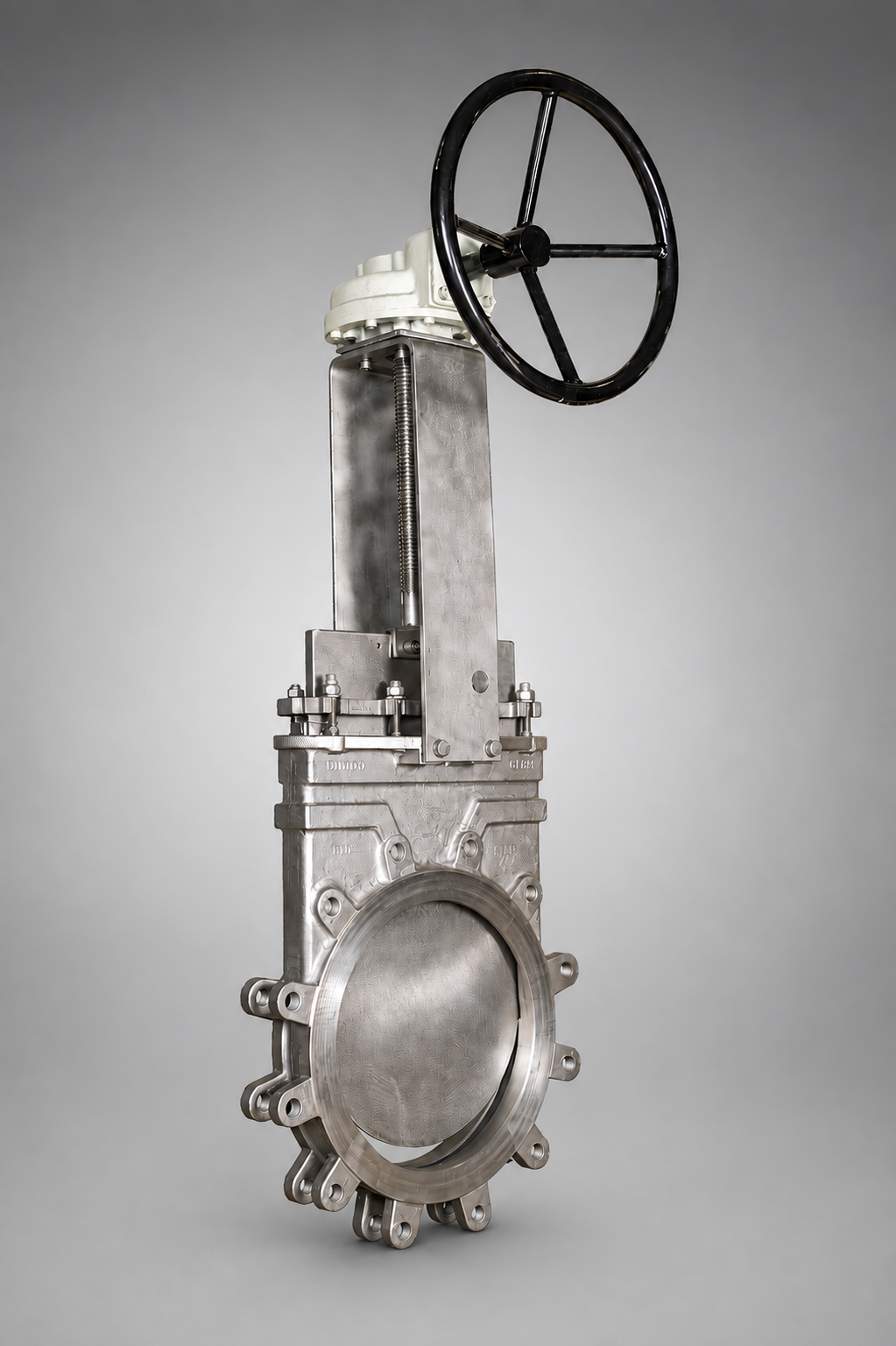
A practical guide to Knife Gate Valve sizing using flow rate, velocity, effective port area, pressure, differential pressure and application conditions.
Selecting the correct valve size is an important part of designing and operating industrial and municipal piping systems, including water, wastewater, sewage, sludge, slurry, mining, pulp and paper, cement and other process applications.
A valve that is too small may create excessive flow velocity and pressure loss, while an incorrectly selected valve may experience premature seat wear, difficult operation or inadequate shut-off performance.
Simply selecting a Knife Gate Valve equal to the pipeline diameter without checking the application may also result in an unsuitable valve selection.
A Knife Gate Valve Manufacturer in India should therefore consider more than nominal pipeline size when evaluating a valve requirement. Flow rate, actual flow passage, velocity, operating pressure, differential pressure, temperature, media characteristics, solids concentration, pressure rating, seat material and operating method can all influence the final selection.
For most Knife Gate Valve isolation applications, the nominal valve size commonly matches the nominal pipeline size. However, the final selection should always be verified against the actual application requirements.
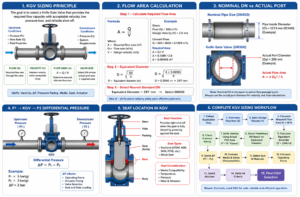
What Is Knife Gate Valve Sizing?
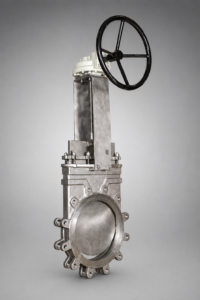
Knife Gate Valve sizing is the process of determining the appropriate valve size and configuration required to safely and reliably isolate or handle a fluid, slurry or solids-containing medium.
Unlike many control valves, Knife Gate Valves are primarily used for isolation service. Therefore, preliminary sizing generally starts with pipeline size, flow rate, velocity and effective flow area, followed by pressure, media and mechanical verification.
When evaluating products from Industrial Valve Manufacturers in India, buyers should understand that valve sizing is application-specific. The same nominal valve size can be used in different industries, but the required construction, seat, material and operating arrangement may vary.
The objective is not simply to select a valve that fits the pipe, but to select a valve that fits the application.
Key Parameters for Knife Gate Valve Sizing
The following parameters should be considered during Knife Gate Valve sizing:
| Parameter | What Needs to Be Checked | Why It Matters |
|---|---|---|
| Pipeline Size | DN / NPS | Establishes preliminary valve size |
| Flow Rate | Minimum / Normal / Maximum | Determines flow capacity |
| Flow Velocity | Design / Actual | Helps determine required flow area |
| Effective Port | Actual valve flow passage | Used for actual velocity calculation |
| Pressure | Operating / Design | Confirms pressure capability |
| Differential Pressure | P₁ − P₂ | Important for operating force and actuator sizing |
| Medium | Water / wastewater / sludge / slurry | Determines construction requirements |
| Solids | Concentration / particle size | Important for sludge and slurry |
| Temperature | Normal / Maximum | Influences seat and materials |
| Seat | EPDM / PTFE / NBR / FKM / Metal | Determines sealing and compatibility |
| Operation | Manual / Pneumatic / Electric | Determines operating requirements |
These parameters provide a practical starting point for valve sizing and selection.
Why Correct Knife Gate Valve Sizing Matters
Correct sizing helps achieve reliable operation while reducing unnecessary pressure loss, wear and maintenance.
| Undersized Valve | Correctly Sized Valve | Oversized Valve |
|---|---|---|
| Higher flow velocity | Appropriate velocity | Unnecessary cost |
| Higher pressure loss | Required flow capacity | Increased weight |
| Possible increased wear | Better service life | Larger actuator may be required |
| Higher operating force | Reliable isolation | More installation space |
| Possible flow restriction | Better overall performance | May be economically inefficient |
For slurry, sludge, wastewater and abrasive applications, correct selection becomes even more important because solids and fluid properties can significantly influence wear, sealing performance and operating force.
A Knife Gate Valve Manufacturer in India can use these application details to determine whether the preliminary valve size is suitable or whether additional engineering checks are required.
Does a Knife Gate Valve Have to Be the Same Size as the Pipeline?
For many isolation applications, the Knife Gate Valve is normally selected to match the nominal pipeline size.
| Pipeline Size | Preliminary KGV Size | Final Verification |
|---|---|---|
| DN100 | DN100 | ✓ |
| DN150 | DN150 | ✓ |
| DN200 | DN200 | ✓ |
| DN250 | DN250 | ✓ |
| DN300 | DN300 | ✓ |
| DN400 | DN400 | ✓ |
| DN500 | DN500 | ✓ |
| DN600 | DN600 | ✓ |
This should be treated as a starting point, not an automatic engineering rule.
The selected valve should still be checked for:
- Flow rate
- Flow velocity
- Actual valve port
- Pressure rating
- Differential pressure
- Fluid characteristics
- Solids concentration
- Temperature
- Valve construction
- Seat arrangement
- Operating requirements
The same approach should be followed when comparing Best Valve Manufacturers in India for a particular industrial application: nominal size is only one part of the overall selection process.
Information Required Before Knife Gate Valve Sizing
Before starting the sizing calculation, collect the required application information.
1. Pipeline & Hydraulic Data
Important information includes:
- Pipeline DN/NPS
- Minimum flow
- Normal flow
- Maximum flow
- Design velocity
- Operating pressure
- Design pressure
- Differential pressure
A Knife Gate Valve Manufacturer in India can use this information as the basis for preliminary hydraulic and mechanical evaluation.
2. Medium Information
Identify exactly what will pass through the valve.
Examples include:
- Raw water
- Treated water
- Wastewater
- Sewage
- Sludge
- Mineral slurry
- Cement-related process media
- Pulp
- Chemical process media
For slurry and sludge applications, also consider solids concentration, density, viscosity, particle size and abrasiveness.
3. Temperature
Provide both normal and maximum operating temperature.
Temperature can influence:
- Valve body material
- Gate material
- Seat material
- Packing
- Sealing performance
4. Operating Method
Specify whether the valve will be:
- Manually operated
- Gear operated
- Pneumatically operated
- Electrically operated
- Hydraulically operated
The operating method affects the mechanical sizing and actuator requirements.
How to Calculate Knife Gate Valve Size
A practical Knife Gate Valve size calculation can be completed using the following steps.
Step 1: Convert Flow Rate
Convert the flow rate into m³/s.
Q = Flow ÷ 3600
For example:
500 ÷ 3600 = 0.1389 m³/s
Step 2: Calculate Required Flow Area
Determine the required flow area using:
A = Q ÷ V
For:
- Q = 0.1389 m³/s
- V = 2.0 m/s
Therefore:
A = 0.1389 ÷ 2.0
A = 0.06945 m²
Step 3: Calculate Equivalent Diameter
Convert the required flow area into an equivalent diameter:
D = √(4A/π)
Using the example:
D = √(4 × 0.06945 / π)
D ≈ 297 mm
Step 4: Select Preliminary DN
Compare the calculated diameter with standard valve sizes.
297 mm → DN300
Therefore, DN300 becomes the preliminary valve size.
Step 5: Check Actual Port
The actual valve flow passage should be verified using manufacturer port data.
For an illustrative 300 mm effective passage:
Area ≈ 0.0707 m²
The actual port should always be confirmed from the selected valve’s technical data rather than assumed from nominal DN alone.
Step 6: Check Actual Velocity
Calculate velocity through the actual valve passage:
V = Q / Aactual
Using the example:
0.1389 ÷ 0.0707
V ≈ 1.96 m/s
This provides a check against the preliminary design velocity.
Step 7: Check Pressure and Differential Pressure
Differential pressure can be calculated as:
ΔP = P₁ − P₂
For example:
5 − 3 = 2 bar
Differential pressure is important for evaluating operating force and actuator requirements.
Step 8: Verify the Application
Check:
- Media
- Solids
- Temperature
- Abrasion
- Pressure
- Operating conditions
A Knife Gate Valve Manufacturer in India should evaluate the complete service condition rather than relying only on calculated diameter.
Step 9: Select Materials
Select suitable:
- Body material
- Gate material
- Seat
- Packing
according to the application.
Step 10: Check Actuator
Determine the required force or torque before selecting a pneumatic, electric or other actuator.
Step 11: Final Verification
Confirm:
- Pressure rating
- Dimensions
- Applicable standards
- Manufacturer data
- Project requirements
before finalizing the valve.
This step-by-step process helps buyers compare technical proposals from Industrial Valve Manufacturers in India using consistent application data.
Worked Knife Gate Valve Sizing Example
Consider an application with the following preliminary requirements:
| Parameter | Result |
|---|---|
| Required Flow | 500 m³/h |
| Flow in m³/s | 0.1389 m³/s |
| Design Velocity | 2.0 m/s |
| Required Flow Area | 0.06945 m² |
| Equivalent Diameter | ≈297 mm |
| Preliminary Valve Size | DN300 |
| Assumed Effective Passage | 300 mm |
| Actual Flow Area | ≈0.0707 m² |
| Calculated Velocity | ≈1.96 m/s |
| Upstream Pressure | 5 bar |
| Downstream Pressure | 3 bar |
| Differential Pressure | 2 bar |
The final calculation should use the actual effective flow passage of the selected valve. Nominal DN should not automatically be assumed to be the exact internal flow diameter.
Why Actual Valve Port Diameter Matters
The nominal valve size and actual flow passage should not automatically be considered identical.
The internal geometry depends on the specific Knife Gate Valve design.
| Valve Data | Purpose |
|---|---|
| Actual Port Diameter | Calculate effective flow area |
| Minimum Flow Passage | Check hydraulic restriction |
| Flow Coefficient | Evaluate flow capacity / pressure loss |
| Valve Flow Data | Verify hydraulic performance |
When evaluating Best Valve Manufacturers in India, buyers should therefore review the actual technical data of the proposed valve rather than comparing only the nominal valve size.
Typical Preliminary Velocity Considerations
There is no single universal velocity limit for every Knife Gate Valve application.
Acceptable velocity depends on:
- Fluid
- Solids
- Particle size
- Abrasiveness
- Pressure
- Temperature
- Valve design
- Pipeline conditions
| Application | Preliminary Consideration | Main Concern |
|---|---|---|
| Clean Water | ~1–3 m/s | Pressure loss |
| Wastewater | ~1.5–3 m/s | Suspended solids |
| Sewage | ~1.5–3 m/s | Fibres / debris |
| Sludge | Application dependent | Solids / viscosity |
| Slurry | Application dependent | Wear / abrasion |
| Highly Abrasive Slurry | Specific evaluation | Erosion / wear |
These are preliminary engineering considerations, not universal allowable limits. Final limits should be established from process design and specific valve/application data.
Knife Gate Valve Sizing for Different Applications
Different applications require different selection considerations.
| Application | Typical Media | Key Sizing Parameters | Main Selection Considerations |
|---|---|---|---|
| Municipal Water | Raw / treated water | Size, flow, velocity, pressure, temperature | Isolation, pressure rating, seat compatibility |
| Wastewater | Wastewater, suspended solids | Flow, solids, velocity, pressure | Port, seat, solids handling |
| Sewage | Sewage, fibres, debris | Flow, solids, particle size, pressure | Gate/seat design, passage |
| Sludge | Primary/secondary sludge | Solids, density, viscosity, flow, pressure | Operating force, port, actuator |
| Slurry | Mineral / abrasive slurry | Solids, particle size, SG, abrasiveness | Wear resistance, materials, seat |
| Mining | Ore slurry / tailings | Solids, particle size, SG, abrasion | Heavy-duty construction |
| Pulp & Paper | Pulp stock / fibres | Flow, consistency, fibre content | Passage, gate and seat |
| Cement / Industrial Slurry | Abrasive process media | Density, solids, particle size, temperature | Wear resistance, sealing |
| Biogas / Waste Handling | Sludge / digestate | Flow, solids, temperature, pressure | Seat/material compatibility |
This application-based approach is useful when comparing Industrial Valve Manufacturers in India, because a manufacturer’s product should be evaluated against the actual process rather than only the product name.
Is Cv/Kv Important for Knife Gate Valve Sizing?
Cv/Kv can be useful for evaluating flow capacity and comparing valve designs.
However, for a typical fully open Knife Gate Valve used for isolation, Cv should not be the only basis for selecting the valve size.
| Application | Importance of Cv/Kv |
|---|---|
| Fully open isolation | Supporting parameter |
| Pressure-loss evaluation | ✓ Important |
| Comparing valve designs | ✓ Important |
| Partial opening | ✓ Important |
| Continuous throttling | ⚠ Detailed evaluation |
| Precision flow control | KGV may not be preferred |
For typical isolation service:
Pipeline Size → Flow → Velocity → Effective Port → Pressure / ΔP → Application Verification
This application-based approach is more useful than relying on one hydraulic coefficient alone.
Knife Gate Valve Seat Selection
Seat material should be selected according to the actual service conditions.
| Seat Material | Typical Applications | Key Advantages | Important Considerations |
|---|---|---|---|
| EPDM | Water / wastewater | Good water compatibility | Check oil/hydrocarbon compatibility |
| PTFE | Chemical / process | Excellent chemical resistance | Check temperature and pressure |
| NBR | Oil-containing media | Good oil resistance | Check temperature and chemicals |
| FKM / Viton | Chemical / higher-temperature service | Good temperature and chemical resistance | Verify specific chemical compatibility |
| Metal | High-temperature / severe service | Suitable for selected severe duties | Leakage/wear differ from soft seats |
| PU | Selected abrasive/slurry service | Good abrasion resistance | Check chemical and temperature compatibility |
Seat selection should always be based on the actual medium, concentration, temperature, pressure, chemical compatibility and solids/abrasiveness.
A Knife Gate Valve Manufacturer in India can use these service conditions to determine the appropriate seat and sealing arrangement for the application.
Knife Gate Valve Operating & Actuator Selection
The operating method also affects valve selection.
| Operating Method | Main Sizing Parameter | Key Factors |
|---|---|---|
| Handwheel | Operating force | Valve size, ΔP, seat and packing friction |
| Gear | Operating torque | Valve size, ΔP, gate load, gearbox ratio |
| Pneumatic | Actuator thrust | Operating force, air pressure, friction, safety factor |
| Electric | Torque / thrust | Force, stroke, operating time, duty cycle |
| Hydraulic | Actuator thrust | Required force, hydraulic pressure, stroke |
Factors Affecting Operating Force
| Factor | Effect |
|---|---|
| Valve Size | Larger valves generally require greater force |
| Differential Pressure | Can increase gate/seat loading |
| Seat Design | Influences friction and sealing load |
| Packing | Adds stem friction |
| Media | Sludge/slurry may increase resistance |
| Operating Frequency | Influences actuator duty |
| Safety Factor | Provides adequate capacity |
| Fail Position | Determines fail-open/fail-closed requirement |
Actuator size should not be selected from valve DN alone. It should be based on the actual valve operating force or torque under the worst expected operating conditions.
Common Knife Gate Valve Sizing Mistakes
| Common Mistake ❌ | Correct Approach ✓ |
|---|---|
| Selecting only from pipeline size | Check flow, velocity and actual port |
| Assuming DN equals actual port | Use effective flow passage |
| Ignoring differential pressure | Check operating force and actuator |
| Using water criteria for slurry | Consider solids and abrasiveness |
| Selecting seat only by availability | Check media and temperature compatibility |
| Selecting actuator from DN alone | Calculate operating force / torque |
| Treating velocity limits as universal | Evaluate the specific application |
| Using Cv as the only criterion | Use the complete application-based approach |
These checks are useful not only for valve sizing but also when comparing Best Valve Manufacturers in India for a particular industrial requirement.
How to Select a Knife Gate Valve Manufacturer
When selecting a manufacturer, technical suitability should come before price alone.
A buyer should evaluate:
- Valve product range
- Manufacturing capability
- Application experience
- Material options
- Seat options
- Pressure ratings
- Testing procedures
- Customization capability
- Actuation options
- Technical support
- Spare-parts availability
A Knife Gate Valve Manufacturer in India should be able to understand the application details and provide technical information needed for final product selection.
Similarly, when comparing Industrial Valve Manufacturers in India, buyers should review the actual technical specifications of the proposed valves and match them with project requirements.
How to Compare the Best Valve Manufacturers in India
There is no universal manufacturer that is automatically the best for every application.
When evaluating Best Valve Manufacturers in India, consider:
Product Suitability
Does the manufacturer offer the required valve type for the application?
Application Experience
Does the manufacturer understand the media and operating environment?
Material Selection
Are appropriate body, gate, seat and packing materials available?
Technical Support
Can the manufacturer assist with valve sizing, selection and operation?
Testing and Quality Control
Are appropriate inspections and tests performed?
Customization
Can the manufacturer provide application-specific configurations when required?
After-Sales Support
Are spare parts and technical assistance available after installation?
These factors provide a more practical way to compare manufacturers than simply comparing prices.
Complete Knife Gate Valve Sizing Workflow
A reliable Knife Gate Valve selection should follow a systematic engineering workflow rather than relying only on pipeline nominal size.
Application Data → Flow Rate → Design Velocity → Required Flow Area → Equivalent Diameter → Preliminary DN → Actual Port → Velocity → Pressure/ΔP → Media/Solids → Seat & Materials → Operating Force → Actuator → Final Verification → Final KGV Selection
This workflow helps ensure that hydraulic, mechanical and application requirements are considered before final selection.
Frequently Asked Questions
1. How do I calculate Knife Gate Valve size?
Start with pipeline size, flow rate and design velocity. Calculate the required flow area, determine the equivalent diameter, select a preliminary valve DN, then verify the actual valve port, velocity, pressure, differential pressure, media, materials and operating requirements.
2. Should the Knife Gate Valve size match the pipeline size?
For many isolation applications, the nominal valve size commonly matches the nominal pipeline size. However, this should be treated as a starting point and verified against flow, velocity, actual port, pressure, media and other application conditions.
3. What information is needed for Knife Gate Valve sizing?
Important information includes pipeline size, flow rate, pressure, differential pressure, temperature, media, solids concentration, particle size, valve operation and required seat/material compatibility.
4. Which factors affect Knife Gate Valve selection?
Flow rate, velocity, pressure, differential pressure, media characteristics, solids, temperature, valve construction, seat material, operating method and actuator requirements all influence selection.
5. Why is actual valve port diameter important?
Nominal DN does not automatically represent the exact internal flow passage. The actual effective port should be checked to calculate flow area and actual velocity.
6. Is Cv/Kv required for Knife Gate Valve sizing?
Cv/Kv can support flow-capacity and pressure-loss evaluation, but it should not be the only basis for sizing a Knife Gate Valve used for typical isolation service.
7. Which seat material is suitable for wastewater?
EPDM is commonly considered for water and wastewater applications, but the final selection should be verified against the actual medium, temperature, pressure and chemical conditions.
8. How is an actuator selected for a Knife Gate Valve?
Actuator selection should be based on actual operating force or torque, considering valve size, differential pressure, seat design, packing friction, media resistance, safety factor and operating frequency.
9. What should I check before selecting a Knife Gate Valve Manufacturer in India?
Check manufacturing capability, product range, application experience, materials, seat options, pressure ratings, testing, customization, technical support and after-sales service.
10. How should I compare Industrial Valve Manufacturers in India?
Compare manufacturers based on technical suitability, product quality, application experience, manufacturing capability, testing, customization, technical support and after-sales service rather than price alone.
11. How can I identify the Best Valve Manufacturers in India?
The right manufacturer depends on the application. Consider product range, manufacturing capability, quality control, technical support, customization, application experience and after-sales support.
12. Can Knife Gate Valves be used for slurry?
Knife Gate Valves can be considered for suitable slurry applications. The final selection should account for solids concentration, particle size, specific gravity, abrasiveness, pressure, temperature, materials and seat design.
Conclusion
Knife Gate Valve sizing is not simply about matching the valve size with the pipeline. A proper selection combines flow rate, velocity, effective port area, pressure, differential pressure, media characteristics, seat design, materials and operating requirements.
Whether the application involves municipal water, wastewater, sewage, sludge, slurry, mining, pulp and paper, cement or other industrial process media, understanding the operating conditions is the first step toward selecting the right Knife Gate Valve.
For buyers evaluating Industrial Valve Manufacturers in India, the most important consideration is whether the proposed valve is technically suitable for the actual process.
A reliable Knife Gate Valve Manufacturer in India should be able to consider the application requirements and provide the relevant technical information for valve selection, sizing and operation.
When comparing Best Valve Manufacturers in India, buyers should therefore look beyond price and consider product suitability, manufacturing capability, application knowledge, material options, testing, customization and technical support.
The right Knife Gate Valve is not simply the valve that fits the pipe — it is the valve that fits the application