
Slurry handling is one of the most demanding tasks in industrial flow control. Unlike clean liquids, slurry contains suspended solid particles that can cause abrasion, sediment buildup, sealing problems, and premature wear. Industries such as mining, wastewater treatment, cement manufacturing, paper and pulp, and mineral processing need valves designed for their specific operating conditions.
Choosing the wrong valve can lead to frequent maintenance, unexpected leakage, production interruptions, and higher operating costs. This is why selecting the right knife gate valve for slurry applications requires careful consideration of the process medium, particle size, solids concentration, pressure, temperature, sealing arrangement, and valve construction.
A knife gate valve is commonly considered for slurry services because its gate moves through the flow path and can help manage certain media containing suspended solids. However, not every knife gate valve is suitable for every slurry. The correct design must match the actual application.
In this guide, we explain how to choose a suitable valve, which technical factors matter most, and what to check when evaluating a Knife Gate Valve Manufacturer in India for your industrial project.
What Is a Knife Gate Valve?
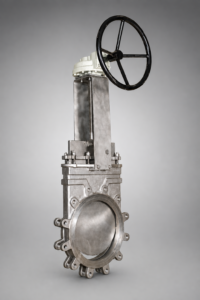
A knife gate valve is an industrial valve that uses a flat, movable gate to start or stop the flow of a medium. Depending on the design, the gate can move through the process material and provide isolation when the valve is closed.
Knife gate valves are used in applications involving liquids, slurries, pulp, wastewater, and certain process media containing suspended solids. Their suitability depends on the valve design, pressure rating, gate and seat materials, and the characteristics of the medium.
Common applications include:
- Mining and mineral processing
- Wastewater treatment plants
- Paper and pulp manufacturing
- Cement and bulk-material processing
- Industrial slurry transfer
- Selected chemical and process industries
- Biogas and waste-management facilities
A Slurry Knife Gate Valve should be selected according to the actual service conditions rather than the application name alone. Two slurry systems may behave very differently because of differences in particle hardness, solids concentration, fluid chemistry, and operating pressure.
Why Is the Right Knife Gate Valve Important for Slurry Applications?
Slurry can create operating challenges that are not typically present in clean-water systems. Solid particles may repeatedly contact internal valve components, while settled material can make opening and closing more difficult.
The main challenges include:
1. Abrasion and Wear
Hard particles such as sand, mineral fragments, and other solids can gradually wear the gate, seat, and body surfaces. The severity depends on particle hardness, particle size, velocity, concentration, and the valve’s construction.
Selecting a valve with suitable wear-resistant materials and a design intended for the application can help manage this risk.
2. Material Buildup
Some slurries contain particles that settle when flow slows or stops. Material can accumulate around the valve’s internal components and interfere with movement or sealing.
The risk depends on the slurry’s properties, pipeline arrangement, operating cycle, and valve design.
3. Leakage and Sealing Problems
Solid particles trapped around the seating area can prevent effective closure. Abrasion, chemical attack, unsuitable elastomers, and damaged sealing surfaces can also contribute to leakage.
A valve should therefore be selected with the required shut-off performance and a sealing arrangement suitable for the medium.
4. Increased Operating Force
Dense or settled slurry can increase the force needed to operate a valve. An actuator that is not sized correctly may struggle to open or close the gate under actual service conditions.
The operating mechanism must be assessed using the valve’s design and expected process loads.
8 Factors to Consider When Choosing a Knife Gate Valve for Slurry Applications
1. Understand the Slurry Composition
The first step is to understand exactly what the valve will handle. The word “slurry” describes a broad range of mixtures, from relatively dilute wastewater to dense, abrasive mineral suspensions.
Before selecting a valve, identify:
- Type of liquid or carrier fluid
- Type of solid particles
- Particle size and hardness
- Solids concentration
- Chemical composition and corrosiveness
- Operating temperature
- Whether the slurry settles or hardens during shutdown
For example, a wastewater application may require a different material and sealing arrangement from a mining process carrying highly abrasive mineral particles.
A reliable Industrial Knife Gate Valve selection starts with these process details. When the operating conditions are unclear, consult the process engineer or valve supplier before finalising the specification.
2. Evaluate Abrasion Resistance
Abrasion is one of the most important considerations when selecting a valve for slurry service. Hard particles can wear the gate and seating components, eventually affecting shut-off performance and maintenance intervals.
An Abrasion Resistant Knife Gate Valve may be appropriate for applications with significant particle wear, provided the complete valve design matches the process conditions.
When evaluating abrasion resistance, consider:
- Particle hardness and shape
- Particle concentration
- Slurry velocity
- Frequency of valve operation
- Gate and seat construction
- Availability and replacement cost of wear components
Do not select a valve based only on a general claim that it is abrasion-resistant. Ask the manufacturer which components are designed for wear and whether the product has experience in similar operating conditions.
3. Choose Suitable Body and Gate Materials
Material selection influences corrosion resistance, mechanical strength, wear behaviour, and service life.
Depending on the application, valve construction may use carbon steel, stainless steel, or other specified alloys. The appropriate choice depends on the process fluid, operating conditions, required strength, and project specifications.
Consider the following:
Carbon steel: May be suitable for many general industrial services when corrosion conditions and protective requirements are properly assessed.
Stainless steel: May be considered where corrosion resistance or particular process conditions require it. The correct grade depends on the chemical composition and operating environment.
Special alloys: May be required for certain corrosive or demanding applications, subject to technical evaluation.
The gate, body, seat, and seals do not necessarily need to use the same material. Each component should be assessed according to its function and exposure to the process medium.
When contacting a Knife Gate Valve Manufacturer in India, share the slurry composition and operating temperature instead of requesting a material based only on the industry name.
4. Select the Correct Seat and Sealing Arrangement
The valve seat is important because it influences shut-off performance and resistance to leakage. The suitable arrangement depends on the slurry characteristics, required isolation, flow direction, and valve design.
During selection, clarify:
- Whether the valve must provide tight shut-off
- Whether leakage is acceptable under the specified conditions
- Whether the slurry contains particles that can collect around the seat
- Whether the medium is chemically compatible with the sealing material
- Whether the valve must seal in one direction or both directions
Elastomeric seals and other seating arrangements have different temperature, chemical compatibility, and wear limitations. Always confirm the suitability of the selected configuration with the manufacturer.
5. Decide Between Uni-Directional and Bi-Directional Designs
Knife gate valves are available in uni-directional and bi-directional configurations. The right choice depends on the direction of flow, pressure conditions, and the required sealing performance.
Uni-directional knife gate valves are designed to provide sealing in a specified direction under their rated conditions. They may be suitable where the process flow and pressure direction are predictable.
Bi-directional knife gate valves are designed for applications that require sealing in both specified flow directions, subject to the product’s ratings and design limitations.
For slurry systems where flow direction can change or pressure may act from either side, a bi-directional design may be worth evaluating. However, reverse-flow capability and shut-off performance should always be confirmed against the manufacturer’s documentation.
Do not assume that every bi-directional valve is suitable for every slurry or that every uni-directional valve is unsuitable. The actual design and operating conditions determine suitability.
6. Check Operating Pressure and Temperature
Every industrial valve has defined operating limits. The valve must be suitable for the maximum expected pressure and temperature, including relevant operating variations.
Before selecting a valve, confirm:
- Normal operating pressure
- Maximum and design pressure
- Normal and maximum temperature
- Pressure direction across the closed valve
- Possible pressure surges or unusual operating conditions
- Required test and inspection criteria
Pressure ratings and shut-off capabilities depend on the specific valve model and configuration. Do not assume that a valve suitable for one pipeline can automatically be used in another pipeline of the same nominal size.
For demanding slurry services, share the process data with the supplier so the proposed configuration can be checked against the application’s requirements.
7. Choose the Right Valve Size and Connection
Valve sizing should consider the pipeline size, required flow, pressure conditions, and installation arrangement. Simply matching the valve’s nominal size to the pipeline does not guarantee that the selected product is suitable.
A valve that is too small may restrict flow or create unwanted pressure loss. An unsuitable design or installation may also contribute to solids accumulation and operational difficulties.
Review the following details:
- Nominal pipe size
- Required flow rate
- Available installation space
- Flange or other connection standard
- Face-to-face dimensions
- Pressure class
- Access for inspection and maintenance
Where slurry contains large or irregular solids, the internal opening and flow-path geometry may be particularly important. Ask for technical drawings and dimensions when the installation has limited space or unusual requirements.
8. Select a Suitable Operating Mechanism
Knife gate valves may use manual, pneumatic, or electric actuation, depending on the design and application.
Manual operation: May be suitable for smaller valves or installations where operation is infrequent and operating forces are manageable.
Pneumatic actuation: May be useful where compressed air is available and remote or automated operation is required.
Electric actuation: May be considered when electrical control and integration with plant automation are needed.
Actuator selection should account for valve size, differential pressure, operating frequency, expected resistance, available utilities, and control requirements. Slurry buildup or changing process conditions can affect the force required to operate the valve.
Confirm actuator sizing with the valve manufacturer rather than selecting an actuator based only on the pipeline diameter.
Common Slurry Applications and Valve Selection Considerations
Different industries have different operating challenges. The following examples illustrate what to evaluate.
Mining and Mineral Processing
Mining slurries can contain hard, abrasive particles that accelerate wear. Buyers should focus on wear-resistant construction, suitable gate and seat materials, operating pressure, and access to replaceable components.
Wastewater Treatment
Wastewater may contain suspended solids, fibres, and other debris. The valve must be compatible with the fluid and capable of handling the expected solids without compromising the required shut-off performance.
Paper and Pulp
Pulp stock and fibre-containing media may create different challenges from mineral slurry. Material consistency, fibre accumulation, seat design, and the operating cycle should be considered.
Cement and Industrial Processing
Some cement-related processes involve abrasive suspensions, while others handle dry bulk materials. The valve type should match the actual medium and operating duty; a valve suitable for slurry is not automatically the best choice for dry powder discharge.
How to Evaluate a Knife Gate Valve Manufacturer in India
Once the technical requirements are clear, evaluate potential suppliers on more than price and delivery time.
Product Range and Application Experience
Confirm whether the supplier manufactures the required knife gate valve design and whether its product range covers the intended operating conditions. Relevant experience with similar media can help the technical discussion, but it should not replace checking the product specification.
Technical Documentation
Ask for applicable drawings, dimensions, material details, pressure ratings, operating instructions, and testing information. Project-specific documentation or certification may also be required.
Quality and Inspection
Understand which quality checks and tests are available for the proposed valve. Verify that the offered inspection and testing procedures match the project’s requirements.
Maintenance and Spare Parts
Check how wear components, seals, and other replacement parts can be obtained. Ask about maintenance access and the recommended inspection procedure for the specific valve model.
Total Cost of Ownership
Compare the complete technical and commercial offer, including initial cost, maintenance needs, spare parts, delivery terms, and support. The lowest purchase price may not result in the lowest operating cost if the valve is poorly suited to the service.
When looking for a Knife Gate Valve Supplier in India, provide the same technical specification to each shortlisted supplier so the quotations can be compared fairly.
Why Consider a Knife Gate Valve Manufacturer in Indore?
For industrial buyers in Madhya Pradesh and other parts of India, researching a Knife Gate Valve Manufacturer in Indore can be one way to identify potential regional suppliers. However, location alone does not establish technical suitability, product quality, or delivery capability.
Buyers should confirm the supplier’s actual manufacturing capabilities, available product configurations, application experience, technical documentation, and ability to meet project requirements.
UUNIQE Ventures Private Limited, based in Indore, Madhya Pradesh, offers industrial valve solutions including uni-directional and bi-directional knife gate valves, slide gate valves, and butterfly valves for selected industrial applications.
For a slurry-related project, share the process medium, particle characteristics, pressure, temperature, flow direction, valve size, and required shut-off performance so the appropriate product can be evaluated. Product suitability should be confirmed against the technical specifications for the intended service.
Website: https://uuniqeventures.com/
Common Mistakes to Avoid When Selecting a Slurry Knife Gate Valve
Avoiding common selection mistakes can help reduce maintenance issues and improve operating reliability.
Choosing based only on price: A low-cost valve may not provide the materials, sealing arrangement, or service support required for abrasive slurry.
Ignoring particle characteristics: Particle hardness, size, and concentration influence wear. The term “slurry” alone is not enough to determine the required construction.
Overlooking flow direction: The selected valve must provide the required sealing performance for the actual pressure and flow direction.
Using unsuitable sealing materials: Seals must be compatible with the process fluid, temperature, and expected wear conditions.
Incorrect actuator sizing: The operating mechanism must be capable of handling the expected loads and service conditions.
Neglecting maintenance access: Even a suitable valve can be difficult to maintain if there is insufficient space for inspection or component replacement.
Assuming every knife gate valve is suitable for slurry: Different designs have different pressure, temperature, solids-handling, and sealing limitations. Always verify the manufacturer’s specified service conditions.
Frequently Asked Questions
1. How do I choose the right knife gate valve for slurry applications?
Start by assessing the slurry composition, particle size and hardness, solids concentration, pressure, temperature, flow direction, and required shut-off performance. Then select the valve’s body, gate, seat, seals, and operating mechanism to match those conditions. Confirm the final selection with the manufacturer’s technical documentation.
2. Which knife gate valve is best for abrasive slurry?
The appropriate valve depends on the abrasive particles, concentration, pressure, temperature, and required service life. A design with suitable wear-resistant components may be appropriate, but no single valve configuration is best for every abrasive slurry. Request application-specific recommendations and confirm the materials and operating limits.
3. What is the difference between uni-directional and bi-directional knife gate valves?
A uni-directional valve is designed to seal in a specified direction, while a bi-directional valve is designed to provide sealing in both specified directions within its rated conditions. Selection depends on the pressure direction, flow requirements, and the specific product design.
4. Which materials are suitable for slurry knife gate valves?
Carbon steel, stainless steel, and specialised alloys may be considered depending on the process medium and operating conditions. Seat and seal materials must also be compatible with the fluid and temperature. Abrasion and corrosion requirements should be assessed separately for the valve’s different components.
5. Can knife gate valves be used in wastewater treatment plants?
Yes, certain knife gate valve designs are used in wastewater applications involving suspended solids. The suitable configuration depends on the wastewater characteristics, pressure, temperature, required shut-off performance, and installation conditions.
6. How often should a slurry knife gate valve be maintained?
There is no universal maintenance interval. Inspection frequency depends on slurry abrasiveness, operating cycles, pressure, temperature, valve design, and service history. Follow the manufacturer’s maintenance guidance and inspect the valve more closely if leakage, difficult operation, or unusual wear appears.
7. What information should I provide when requesting a valve quotation?
Provide the valve size, process medium, particle characteristics, solids concentration, operating and design pressure, temperature, flow direction, connection details, operating mechanism, and required shut-off performance. Drawings and installation details can help the supplier assess the application.
8. How can I find a suitable Knife Gate Valve Manufacturer in India?
Compare manufacturers based on their product specifications, experience with similar applications, material options, technical documentation, inspection procedures, spare-parts availability, and support. Confirm that the proposed model is rated for your actual process conditions before placing an order.
Conclusion
Selecting the right knife gate valve for slurry applications requires a clear understanding of the process medium and the conditions in which the valve will operate. Abrasion, solids concentration, corrosion, sealing performance, pressure, temperature, and actuator sizing all influence the suitability of a valve.
Before purchasing, prepare a detailed specification and discuss it with a qualified supplier. Compare technical compliance, maintenance requirements, available documentation, and long-term operating value rather than choosing on initial price alone.
For industrial projects requiring knife gate valves, UUNIQE Ventures can be considered as a potential supplier based on the product configuration and application requirements. Confirm the proposed valve’s technical suitability before finalising your selection.