What Is a Knife Gate Valve?
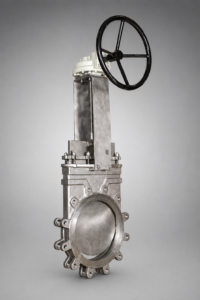
A Knife Gate Valve is a specially engineered industrial valve designed to isolate or control the flow of thick fluids, slurries, powders, wastewater, pulp, and other media containing solid particles. Unlike a conventional gate valve, a knife gate valve features a sharp-edged stainless steel gate that cuts through suspended solids and fibrous materials during operation.
Because of its simple yet robust design, the knife gate valve is widely used in industries where traditional valves often fail due to clogging, abrasion, or excessive wear.
Industries across India, the USA, Canada, Germany, France, Italy, and other European countries rely on knife gate valves for reliable shut-off in demanding process applications. Their ability to handle abrasive and viscous media makes them an ideal solution for modern industrial plants.
As a trusted Knife Gate Valve Manufacturer in Indore, India, UUNIQE Ventures designs and manufactures precision-engineered valves that meet international quality standards for both domestic and export markets.
How Does a Knife Gate Valve Work?
The operating principle of a knife gate valve is straightforward yet highly effective.
When the handwheel, gearbox, pneumatic actuator, or electric actuator is operated, the gate moves vertically inside the valve body.
Valve Opening Process
When the valve opens:
- The stainless steel blade moves upward.
- The flow passage becomes fully open.
- Fluids containing solids pass with minimal obstruction.
- Pressure loss remains low.
Valve Closing Process
When the valve closes:
- The sharpened gate moves downward.
- The blade cuts through slurry, fibers, or suspended solids.
- The seat forms a tight seal.
- Flow stops completely.
This cutting action is the primary reason why knife gate valves outperform conventional gate valves in slurry and wastewater applications.
Why Is It Called a Knife Gate Valve?
The valve gets its name from the knife-shaped gate.
Unlike ordinary gate valves that have a thick wedge-shaped gate, a knife gate valve has a thin, sharp-edged blade capable of cutting through:
- Sludge
- Paper pulp
- Mining slurry
- Fly ash
- Cement powder
- Wastewater solids
- Biomass
- Fibrous materials
This unique design significantly reduces blockage and ensures smooth operation even in harsh industrial environments.
Main Components of a Knife Gate Valve
Every industrial knife gate valve consists of several precision-engineered components that work together to ensure reliable performance.
1. Valve Body
The body is the primary pressure-containing component of the valve.
Common body materials include:
- Cast Iron
- Ductile Iron
- Carbon Steel
- Stainless Steel (SS304)
- Stainless Steel (SS316)
The body material is selected according to pressure, temperature, corrosion resistance, and application requirements.
2. Knife Gate (Blade)
The blade is the heart of the valve.
Its sharpened edge cuts through abrasive media during closing while providing complete shut-off.
High-quality blades are usually manufactured from:
- SS304
- SS316
- Duplex Stainless Steel
- Hardened Stainless Steel
3. Seat
The valve seat provides sealing between the blade and the valve body.
Depending on the application, different seat materials are used:
- EPDM
- NBR
- PTFE
- Metal Seat
The correct seat material greatly influences valve life and sealing performance.
4. Stem
The stem transfers motion from the actuator or handwheel to the gate.
It is generally manufactured using corrosion-resistant stainless steel to ensure long service life.
5. Gland Packing
Packing prevents leakage around the stem while allowing smooth movement.
Proper gland adjustment improves valve sealing and reduces maintenance costs.
6. Actuator
Knife gate valves can be operated manually or automatically.
Popular actuation options include:
- Handwheel
- Gearbox
- Pneumatic Actuator
- Electric Actuator
- Hydraulic Actuator
- Chain Wheel
The actuator selection depends on plant automation requirements.
Where Are Knife Gate Valves Used?
Knife gate valves are widely used in industries where conventional valves struggle due to abrasive, corrosive, or solid-laden media.
Water & Wastewater Treatment
Wastewater treatment plants use knife gate valves to isolate sludge lines, clarifiers, and treatment systems.
Their ability to handle suspended solids makes them an industry standard.
Mining Industry
Mining operations transport highly abrasive slurry containing minerals, sand, and rock particles.
Knife gate valves provide reliable shut-off while minimizing wear.
Paper & Pulp Industry
Paper mills handle pulp, fibers, chemicals, and recycled materials.
Knife gate valves prevent clogging and maintain uninterrupted production.
Cement Plants
Cement manufacturing involves powders, clinker dust, and fly ash.
Knife gate valves control these difficult materials with excellent reliability.
Power Plants
Thermal and biomass power plants use knife gate valves for:
- Fly ash handling
- Bottom ash systems
- Slurry transportation
- Water treatment
Chemical Processing
Chemical industries require corrosion-resistant valves capable of handling aggressive fluids.
Stainless steel knife gate valves are commonly selected for these applications.
Steel Plants
Steel manufacturing facilities use knife gate valves for:
- Cooling water
- Slag handling
- Dust collection systems
- Wastewater treatment
Food & Biogas Plants
Special hygienic knife gate valves are used in:
- Biogas plants
- Food processing
- Sugar industries
- Distilleries
Why Are Knife Gate Valves Preferred for Slurry Applications?
Slurry is one of the most challenging media to control because it contains a mixture of liquid and solid particles.
Traditional valves often experience:
- Clogging
- Erosion
- Leakage
- High maintenance
- Frequent downtime
Knife gate valves overcome these challenges due to their unique design.
Key Benefits for Slurry Service
✔ Sharp blade cuts through solids.
✔ Full-port opening reduces clogging.
✔ Lower pressure drop.
✔ Handles abrasive materials efficiently.
✔ Easy maintenance.
✔ Longer service life.
✔ Lower operating costs.
For industries such as mining, wastewater, cement, and paper processing, knife gate valves offer superior performance and reliability compared to many conventional valve designs.
Why Global Industries Trust Indian Knife Gate Valve Manufacturers
India has emerged as a major manufacturing hub for industrial valves, supplying high-quality products to customers worldwide. Manufacturers based in industrial cities such as Indore combine skilled engineering, modern production facilities, and competitive pricing to serve EPC contractors, OEMs, distributors, and end users across the USA, Canada, and Europe.
At UUNIQE Ventures, we focus on delivering precision-engineered knife gate valves that meet international expectations for quality, durability, and performance. Every valve is designed with strict quality control and export-ready manufacturing practices to ensure dependable operation in demanding industrial environments.
Advantages of a Knife Gate Valve
A Knife Gate Valve has become one of the most preferred industrial valves for handling abrasive, viscous, and solid-laden media. Its simple yet robust construction provides excellent reliability in demanding industries such as mining, wastewater treatment, cement, pulp & paper, power generation, and chemical processing.
Unlike traditional gate valves, a knife gate valve is specifically engineered to perform in applications where clogging, erosion, and frequent maintenance are common challenges.
Below are the major advantages of using a knife gate valve.
1. Excellent Performance in Slurry Applications
One of the biggest advantages of a knife gate valve is its ability to handle slurry efficiently.
Slurry is a mixture of liquid and solid particles that can quickly damage conventional valves. The sharp stainless-steel gate cuts through solids while closing, preventing blockage and ensuring smooth shut-off.
This makes knife gate valves the preferred choice for:
- Mining slurry
- Fly ash
- Paper pulp
- Wastewater sludge
- Cement powder
- Biomass
- Chemical slurry
2. Full Bore Flow Design
Knife gate valves offer a full-port opening, allowing media to pass with minimal restriction.
Benefits include:
- Low pressure drop
- Better flow efficiency
- Reduced turbulence
- Less material accumulation
This design is particularly important in industries transporting thick or abrasive materials.
3. Compact and Lightweight Design
Compared to conventional gate valves, knife gate valves are much thinner and lighter.
Advantages include:
- Easier installation
- Lower transportation cost
- Reduced piping load
- Less installation space
This compact design is highly appreciated in modern industrial plants where space optimization is important.
4. Lower Maintenance Cost
Since the valve has fewer internal components and a simple operating mechanism, maintenance becomes easier.
Routine inspection generally includes:
- Checking gland packing
- Inspecting the blade
- Lubricating the stem
- Verifying seat condition
Lower maintenance directly reduces plant downtime and operating costs.
5. Excellent Shut-Off Capability
Knife gate valves provide reliable isolation in pipelines carrying difficult media.
When fully closed, the sharpened gate compresses against the seat to stop the flow efficiently.
For isolation service, they provide dependable sealing in many industrial applications.
6. Suitable for Manual and Automated Systems
Modern industries increasingly rely on automation.
Knife gate valves can be supplied with:
- Manual Handwheel
- Gear Operator
- Pneumatic Actuator
- Electric Actuator
- Hydraulic Actuator
This flexibility makes them suitable for both small industrial units and fully automated processing plants.
7. Cost-Effective Solution
Compared with several heavy-duty industrial valve types, knife gate valves often provide an economical solution for slurry handling.
Industries benefit from:
- Lower purchase cost
- Longer operational life
- Reduced maintenance expenses
- Improved process efficiency
Limitations of Knife Gate Valves
Although knife gate valves offer numerous advantages, they are not suitable for every application.
Understanding their limitations helps engineers select the right valve for each service.
1. Not Ideal for High Pressure Applications
Standard knife gate valves are generally designed for low to medium pressure services.
Applications requiring extremely high pressure often use:
- Gate Valves
- Ball Valves
- Globe Valves
Always verify the pressure rating before valve selection.
2. Limited Throttling Capability
Knife gate valves are primarily designed for ON/OFF isolation.
Keeping the valve partially open for long periods can:
- Increase blade wear
- Damage the seat
- Cause vibration
- Reduce service life
For continuous flow regulation, globe valves or control valves are generally more suitable.
3. Possible Seat Wear
Highly abrasive materials can gradually wear the valve seat over time.
Proper seat selection and regular maintenance significantly improve valve life.
4. Slower Operation in Manual Systems
Large-diameter manual knife gate valves may require more operating turns.
Using pneumatic or electric actuators helps improve operating speed and efficiency.
Knife Gate Valve vs Gate Valve
Many buyers ask:
“What is the difference between a Knife Gate Valve and a Gate Valve?”
Although both are isolation valves, they are designed for completely different applications.
Feature Knife Gate Valve Gate Valve Primary Use Slurry, sludge, powders Clean liquids & gases Gate Design Sharp blade Thick wedge gate Body Width Thin Thick Solids Handling Excellent Poor Slurry Service Excellent Not Recommended Pressure Rating Low to Medium Medium to High Cost Economical Usually Higher Maintenance Lower Moderate
Why Are Knife Gate Valves Thinner Than Gate Valves?
One of the most noticeable differences is the valve body thickness.
Knife gate valves use a thin body because they are designed mainly for shut-off service, not for very high-pressure systems.
This offers several benefits:
- Reduced weight
- Lower manufacturing cost
- Easier installation
- Compact piping layout
The slim body design also makes them popular in large process plants where installation space is limited.
Which Valve Is Better for Slurry Applications?
For slurry handling, knife gate valves are generally the preferred choice.
They are specifically designed to manage:
- Abrasive particles
- Thick fluids
- Fibrous materials
- Waste sludge
- Mining slurry
- Cement dust
- Fly ash
A conventional gate valve may become blocked or experience excessive wear in these services, whereas a knife gate valve is engineered to reduce such issues through its sharp-edged gate and full-port design.
Can Knife Gate Valves Be Used for Throttling?
Technically, a knife gate valve can be partially opened for limited flow control in some applications. However, it is not recommended for continuous throttling.
Using the valve in a partially open position for extended periods may:
- Increase erosion on the gate
- Accelerate seat wear
- Reduce sealing performance
- Shorten the valve’s service life
For precise and continuous flow regulation, engineers typically choose dedicated control valves or globe valves.
Which Industries Prefer Knife Gate Valves Over Gate Valves?
Several industries choose knife gate valves because of their ability to handle difficult media.
Mining Industry
Used for transporting abrasive mineral slurry and tailings.
Water & Wastewater Treatment
Ideal for sludge lines, clarifiers, and dewatering systems.
Paper & Pulp Industry
Handles pulp, fibers, and recycled paper without clogging.
Cement Industry
Controls clinker dust, fly ash, and powdered materials.
Steel Plants
Suitable for dust collection systems, slag handling, and wastewater treatment.
Chemical Processing
Available in corrosion-resistant materials for aggressive chemicals.
Power Generation
Used in ash handling systems and industrial water treatment plants.
These industries require reliable shut-off and minimal downtime, making knife gate valves a preferred solution.
What Are the Pressure Limitations of Knife Gate Valves?
The pressure capability of a knife gate valve depends on factors such as:
- Valve design
- Body material
- Seat material
- Manufacturing standards
- Application requirements
Many industrial knife gate valves are designed for low to medium pressure services, which are common in slurry handling, wastewater treatment, and bulk material transport.
For higher-pressure applications, consult the valve manufacturer to select the appropriate design and pressure class.
Why Buyers in India, USA, Canada, and Europe Choose Knife Gate Valves
Industrial buyers across India, the USA, Canada, and Europe look for valves that offer reliable performance, reduced maintenance, and long service life in demanding environments.
Modern knife gate valves meet these expectations by providing:
- Efficient slurry handling
- Durable construction
- Compact installation
- Easy maintenance
- Compatibility with automated systems
- Cost-effective lifecycle performance
Manufacturers with export-focused production and strict quality control, such as UUNIQE Ventures, supply precision-engineered knife gate valves that are suitable for industries worldwide. By combining advanced manufacturing practices with international quality standards, they support EPC contractors, OEMs, and industrial facilities seeking dependable flow control solutions.
Knife Gate Valve Types and Material Selection
Choosing the right Knife Gate Valve is about more than selecting the correct size. Industrial applications vary significantly depending on operating pressure, temperature, media type, abrasion, corrosion, and installation requirements.
Whether you are designing a wastewater treatment plant in India, a mining project in Canada, a pulp and paper mill in the USA, or a chemical processing facility in Europe, selecting the appropriate valve type and material directly affects system reliability, maintenance costs, and operational efficiency.
As an experienced Knife Gate Valve Manufacturer in India, UUNIQE Ventures offers customized valve solutions designed to meet diverse industrial requirements while complying with international quality standards.
Types of Knife Gate Valves
Knife gate valves are available in several configurations, each designed for specific industrial applications.
1. Bi-Directional Knife Gate Valve
A Bi-Directional Knife Gate Valve provides sealing in both flow directions. Unlike uni-directional valves, it can isolate flow regardless of the direction of the process media.
Key Features
- Seals in both directions
- Suitable for reversible pipelines
- Excellent shut-off performance
- Longer service life
- Easy installation without considering flow direction
Common Applications
- Water treatment plants
- Chemical processing
- Food processing
- Power generation
- Steel plants
Advantages
- Flexible installation
- Lower inventory requirements
- Reliable sealing
- Reduced maintenance
2. Uni-Directional Knife Gate Valve
A Uni-Directional Knife Gate Valve is designed to seal in only one direction. An arrow marked on the valve body indicates the correct flow direction.
Best For
- Slurry pipelines
- Mining plants
- Paper industries
- Wastewater systems
Advantages
- Better sealing under specific pressure conditions
- Economical design
- Ideal for abrasive media
- Lightweight construction
Bi-Directional vs Uni-Directional Knife Gate Valve
Feature Bi-Directional Uni-Directional Flow Direction Both Directions One Direction Installation Flexible Flow Direction Required Sealing Double Direction Single Direction Slurry Service Excellent Excellent Cost Slightly Higher More Economical For applications with changing flow direction, a bi-directional knife gate valve is generally the preferred option.
3. Wafer Type Knife Gate Valve
A Wafer Type Knife Gate Valve is designed to fit between two pipeline flanges.
Its compact body reduces overall weight while minimizing installation space.
Benefits
- Lightweight
- Cost-effective
- Compact design
- Easy installation
- Reduced piping load
Industries
- Wastewater treatment
- Mining
- Chemical processing
- Cement
- Paper & Pulp
4. Lug Type Knife Gate Valve
A Lug Type Knife Gate Valve features threaded lugs on both sides of the valve body.
This design allows one side of the pipeline to be removed without disturbing the opposite side.
Advantages
- Easier maintenance
- Supports dead-end service
- Better pipeline flexibility
- Suitable for plant shutdown maintenance
5. Flanged Knife Gate Valve
Flanged knife gate valves are bolted directly between pipeline flanges.
They are preferred where additional strength and leak-tight connections are required.
Features
- Strong mechanical connection
- Excellent alignment
- Reliable sealing
- Suitable for larger pipe sizes
6. Rising Stem Knife Gate Valve
In this design, the stem moves upward while opening the valve.
Operators can easily determine whether the valve is open or closed simply by observing the stem position.
Advantages
- Easy visual indication
- Better maintenance access
- Simple inspection
- Preferred for outdoor installations
7. Non-Rising Stem Knife Gate Valve
In non-rising stem valves, only the gate moves while the stem remains in the same position.
Benefits
- Requires less vertical space
- Suitable for underground installations
- Ideal where overhead clearance is limited
8. Through Conduit Knife Gate Valve
A Through Conduit Knife Gate Valve provides an uninterrupted full bore passage when fully open.
Advantages
- Minimal pressure loss
- Reduced material accumulation
- Improved flow efficiency
- Better cleaning performance
These valves are often selected for pipelines carrying highly abrasive materials.
Knife Gate Valve Seat Selection
Selecting the correct seat material is equally important as selecting the valve body.
Different industries require different sealing materials based on media, temperature, and chemical compatibility.
Metal Seated Knife Gate Valve
A metal seat is recommended for:
- High temperature applications
- Abrasive media
- Dry powders
- Fly ash
- Cement
- Mining
Advantages
- Excellent wear resistance
- High temperature capability
- Longer life in abrasive service
Resilient Seated Knife Gate Valve
Resilient seats use elastomer materials to provide bubble-tight sealing.
Suitable for:
- Water
- Wastewater
- Sludge
- Mild chemicals
Advantages
- Better sealing
- Lower leakage
- Easy maintenance
- Reduced operating torque
EPDM vs PTFE vs NBR Seat – Which Is Better?
Selecting the correct seat material significantly improves valve life.
EPDM Seat
Suitable for:
- Water
- Wastewater
- Mild chemicals
Advantages:
- Excellent weather resistance
- Good flexibility
- Cost-effective
PTFE Seat
Recommended for:
- Chemical processing
- Corrosive fluids
- Pharmaceutical industries
Advantages:
- Excellent chemical resistance
- Low friction
- High purity applications
NBR Seat
Best suited for:
- Oil
- Petroleum products
- Grease
- Hydrocarbon service
Advantages:
- Good oil resistance
- Durable
- Economical
Quick Comparison
Seat Material Best For EPDM Water & Wastewater PTFE Corrosive Chemicals NBR Oil & Petroleum
Knife Gate Valve Body Material Selection
The valve body material determines the valve’s strength, corrosion resistance, and service life.
SS304 vs SS316 Knife Gate Valve
One of the most common questions from industrial buyers is:
Which is better: SS304 or SS316?
SS304
Advantages:
- Economical
- Good corrosion resistance
- Suitable for general industrial service
- Easy availability
Applications:
- Food industry
- Water treatment
- Paper mills
- General processing
SS316
Contains molybdenum, providing superior corrosion resistance.
Applications:
- Marine environments
- Chemical processing
- Pharmaceutical plants
- Saltwater service
Advantages:
- Better corrosion resistance
- Longer service life
- Excellent chloride resistance
Which One Should You Choose?
- SS304 is ideal for standard industrial applications with mild operating conditions.
- SS316 is the better choice for corrosive chemicals, coastal environments, and chloride-rich media due to its enhanced resistance to corrosion.
Cast Iron vs Ductile Iron Knife Gate Valve
Both materials are widely used in industrial valve manufacturing.
Cast Iron
Advantages
- Lower cost
- Good machinability
- Suitable for low-pressure service
Applications
- Water systems
- General industrial plants
Ductile Iron
Advantages
- Higher tensile strength
- Better impact resistance
- Longer service life
- Improved durability
Applications
- Wastewater treatment
- Mining
- Heavy industry
- Municipal projects
Comparison
Property Cast Iron Ductile Iron Strength Moderate High Impact Resistance Lower Higher Durability Good Excellent Heavy-Duty Applications Limited Recommended
What Is CF8 vs CF8M in Knife Gate Valves?
CF8 and CF8M are stainless steel casting grades commonly used in industrial valves.
CF8
Equivalent to SS304.
Best for:
- Fresh water
- General industrial service
- Food processing
CF8M
Equivalent to SS316.
Best for:
- Chemical plants
- Marine service
- Corrosive environments
- Pharmaceutical industries
Because CF8M contains molybdenum, it provides improved resistance to pitting and corrosion compared with CF8.
Which Material Is Best for Corrosive Media?
There is no single material that is ideal for every corrosive application. Material selection should be based on the process fluid, operating temperature, pressure, and chemical compatibility.
As a general guideline:
- SS316 / CF8M – Suitable for many corrosive chemicals and marine environments.
- PTFE Seats – Excellent for aggressive chemical media.
- EPDM Seats – Preferred for water and wastewater applications.
- Ductile Iron Bodies – Well suited for demanding municipal and industrial services.
- Cast Iron Bodies – Cost-effective for general-purpose, lower-pressure applications.
Consulting an experienced Knife Gate Valve Manufacturer ensures the valve materials are matched correctly to the operating conditions, helping maximize service life and minimize maintenance.
Choosing the Right Knife Gate Valve
Before purchasing a knife gate valve, consider the following factors:
- Type of media (slurry, water, chemicals, powders)
- Operating pressure and temperature
- Corrosion and abrasion levels
- Installation orientation
- Manual or automated operation
- Applicable industry standards (ANSI, MSS SP-81, DIN, EN, ISO)
- Future maintenance requirements
Working with an experienced manufacturer such as UUNIQE Ventures helps ensure the selected valve meets the performance requirements of projects across India, the USA, Canada, and Europe, while delivering long-term reliability and consistent operation.
Knife Gate Valve Installation, Maintenance, Testing & Buying Guide (2026)
Knife Gate Valve Problems & Maintenance
Even a high-quality Knife Gate Valve requires proper installation and routine maintenance to ensure reliable performance and long service life. Industrial valves operating in slurry, wastewater, mining, chemical, and cement applications are continuously exposed to abrasive and corrosive media. Preventive maintenance helps reduce downtime and unexpected failures.
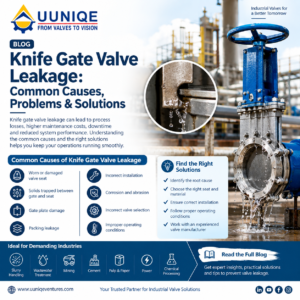
Why Does a Knife Gate Valve Leak?
Valve leakage can occur for several reasons. Identifying the root cause early helps prevent damage to the pipeline and improves operational safety.
Common Causes of Leakage
- Worn or damaged valve seat
- Improper installation
- Damaged gland packing
- Corrosion on the gate blade
- Solid particles trapped between the gate and seat
- Incorrect actuator adjustment
- Excessive operating pressure
How to Prevent Leakage
- Inspect the valve periodically.
- Clean the gate and sealing surfaces.
- Replace damaged packing and worn seats when required.
- Use the correct valve size and pressure rating.
- Follow the manufacturer’s installation guidelines.
Why Does a Knife Gate Valve Get Stuck?
A knife gate valve may become difficult to operate if it is not maintained properly or is used in unsuitable operating conditions.
Possible Reasons
- Slurry or debris accumulation around the gate
- Lack of stem lubrication
- Corrosion on moving components
- Bent or damaged stem
- Incorrect installation alignment
- Long periods without operation
Preventive Measures
- Operate the valve periodically, even if it is not used daily.
- Lubricate the stem according to the maintenance schedule.
- Flush slurry lines when possible.
- Inspect the blade for wear or corrosion.
What Causes Packing Leakage in Knife Gate Valves?
Packing leakage usually occurs around the valve stem and is one of the most common maintenance issues.
Causes
- Loose gland bolts
- Worn gland packing
- Incorrect packing material
- Excessive stem wear
- High operating temperature
- Chemical attack on packing material
Solution
- Tighten the gland evenly.
- Replace worn packing with the correct material.
- Avoid over-tightening, as this can increase operating torque.
- Use packing suitable for the application and media.
How to Replace Gland Packing in a Knife Gate Valve
Replacing gland packing is a routine maintenance task that restores sealing performance.
Step 1 – Isolate the Valve
Ensure the pipeline is depressurized and isolated before beginning maintenance.
Step 2 – Open the Valve
Move the gate to the open position to reduce pressure on the packing.
Step 3 – Remove the Gland
Loosen the gland bolts and carefully lift the gland follower.
Step 4 – Remove Old Packing
Use appropriate tools to remove all old packing rings without damaging the stem.
Step 5 – Install New Packing
Insert new packing rings one at a time, ensuring proper alignment.
Step 6 – Tighten the Gland
Tighten the gland bolts evenly until the recommended compression is achieved.
Step 7 – Test the Valve
Operate the valve several times and inspect for leakage before returning it to service.
How to Maintain Knife Gate Valves
Preventive maintenance increases valve life and minimizes downtime.
Recommended Maintenance Checklist
- Inspect the valve body for external damage.
- Clean the gate and sealing surfaces.
- Lubricate the stem.
- Check gland packing for leakage.
- Inspect actuator mounting.
- Verify fastener tightness.
- Operate the valve periodically.
- Replace worn components when necessary.
How Often Should Knife Gate Valves Be Serviced?
The service interval depends on operating conditions, media type, and valve usage.
Typical Recommendations
- High-duty slurry service: Inspect every 3–6 months.
- General industrial service: Inspect every 6–12 months.
- Critical process lines: Follow the plant’s preventive maintenance schedule and manufacturer’s recommendations.
Regular inspections reduce unexpected failures and extend service life.
How to Troubleshoot Knife Gate Valve Failures
When a valve is not performing as expected, consider the following checklist:
Problem | Possible Cause | Solution
Problem Possible Cause Solution Leakage Damaged seat or packing Replace worn parts Valve difficult to operate Debris or lack of lubrication Clean and lubricate Incomplete closing Material trapped in seat Flush and inspect Excessive operating torque Corrosion or misalignment Inspect stem and actuator External leakage Loose gland Tighten or replace packing
How to Prevent Seat Damage in Knife Gate Valves
Seat damage can lead to leakage and reduced valve performance.
Best Practices
- Select the correct seat material for the process media.
- Avoid throttling unless the valve is designed for it.
- Remove debris before closing the valve.
- Perform regular inspections.
- Operate within the recommended pressure and temperature limits.
Knife Gate Valve Installation Guide
Proper installation is essential for reliable valve performance.
Installation Best Practices
- Inspect the valve before installation.
- Ensure the pipeline is clean and free of debris.
- Verify flange alignment.
- Use the correct gasket.
- Tighten flange bolts evenly using a cross pattern.
- Do not use excessive force during installation.
- Confirm the flow direction for uni-directional valves.
Can Knife Gate Valves Be Installed Horizontally?
Yes, knife gate valves can be installed horizontally, provided the installation follows the manufacturer’s recommendations and the application allows it.
For heavy valves or automated actuators, adequate support should be provided to prevent unnecessary stress on the pipeline.
What Gasket Should Be Used for Knife Gate Valves?
The gasket should be selected according to the process conditions.
Common gasket materials include:
- EPDM
- PTFE
- Graphite
- Spiral Wound Gaskets
- Non-Asbestos Gaskets
Choosing the correct gasket improves sealing performance and reduces the risk of leakage.
What Is Hydrostatic Testing in Knife Gate Valves?
Hydrostatic testing verifies the structural integrity of the valve body.
During the test:
- The valve is filled with water.
- Pressure is applied according to the specified standard.
- The valve body is inspected for leakage or deformation.
Hydrostatic testing helps ensure that the valve can safely withstand its rated pressure.
What Is a Seat Leakage Test?
The seat leakage test checks the sealing performance between the gate and the seat.
The objective is to confirm that the valve provides the required level of shut-off under test conditions.
This test is commonly performed before shipment and during quality inspections.
What Is MSS SP-81 Standard?
MSS SP-81 is an internationally recognized standard for Knife Gate Valves.
It provides guidance on:
- Design requirements
- Face-to-face dimensions
- Pressure ratings
- Testing procedures
- Inspection requirements
- Manufacturing practices
Many industrial buyers in India, the USA, Canada, and Europe prefer valves manufactured in accordance with recognized international standards such as MSS SP-81.
What Is Valve Pressure Testing?
Pressure testing confirms that the valve can safely withstand its rated operating pressure.
Typical pressure tests include:
- Hydrostatic shell test
- Seat leakage test
- Operational test
These tests help ensure product quality before installation.
Frequently Asked Questions (FAQs)
What is a Knife Gate Valve used for?
Knife gate valves are primarily used for isolating the flow of slurry, wastewater, pulp, powders, and other media containing suspended solids.
Which industries use Knife Gate Valves?
Mining, wastewater treatment, paper & pulp, cement, steel, chemical processing, power generation, and biogas industries commonly use knife gate valves.
Can Knife Gate Valves handle slurry?
Yes. They are specifically designed to handle abrasive slurry and solid-laden media.
Which material is best for corrosive applications?
SS316 (CF8M) with PTFE seating is often selected for corrosive chemical applications, depending on the process conditions.
Are Knife Gate Valves suitable for high-pressure applications?
Most standard knife gate valves are intended for low to medium pressure services. Higher-pressure applications may require alternative valve designs.
What is the difference between a Knife Gate Valve and a Gate Valve?
Knife gate valves are designed for slurry and solids, whereas conventional gate valves are generally intended for clean liquids and gases.
How often should Knife Gate Valves be maintained?
Maintenance frequency depends on the application, media, and operating conditions. Regular inspections and preventive maintenance help maximize service life.
Why Choose UUNIQE Ventures?
At UUNIQE Ventures, we specialize in manufacturing precision-engineered Knife Gate Valves designed for demanding industrial applications. As a Knife Gate Valve Manufacturer in Indore, India, we combine engineering expertise with export-focused manufacturing to serve customers across India, the USA, Canada, Europe, and other international markets.
Our product range is designed to deliver:
- Reliable shut-off performance
- Durable construction
- High-quality materials
- Compliance with international standards
- Customization for specific industrial requirements
- Consistent quality and on-time delivery
Whether you require valves for mining, wastewater treatment, pulp & paper, cement, power generation, or chemical processing, our team is committed to providing dependable flow control solutions tailored to your operational needs.
Request a Free Quote
Looking for a trusted Knife Gate Valve Manufacturer in India?
Contact UUNIQE Ventures for high-performance industrial valve solutions designed to meet global quality standards. Our experienced team can help you select the right valve configuration for your application and support your project from design to delivery.