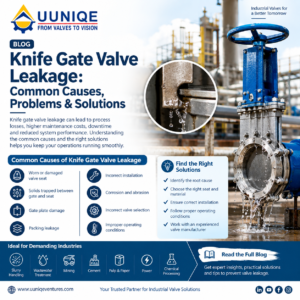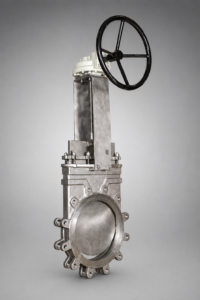
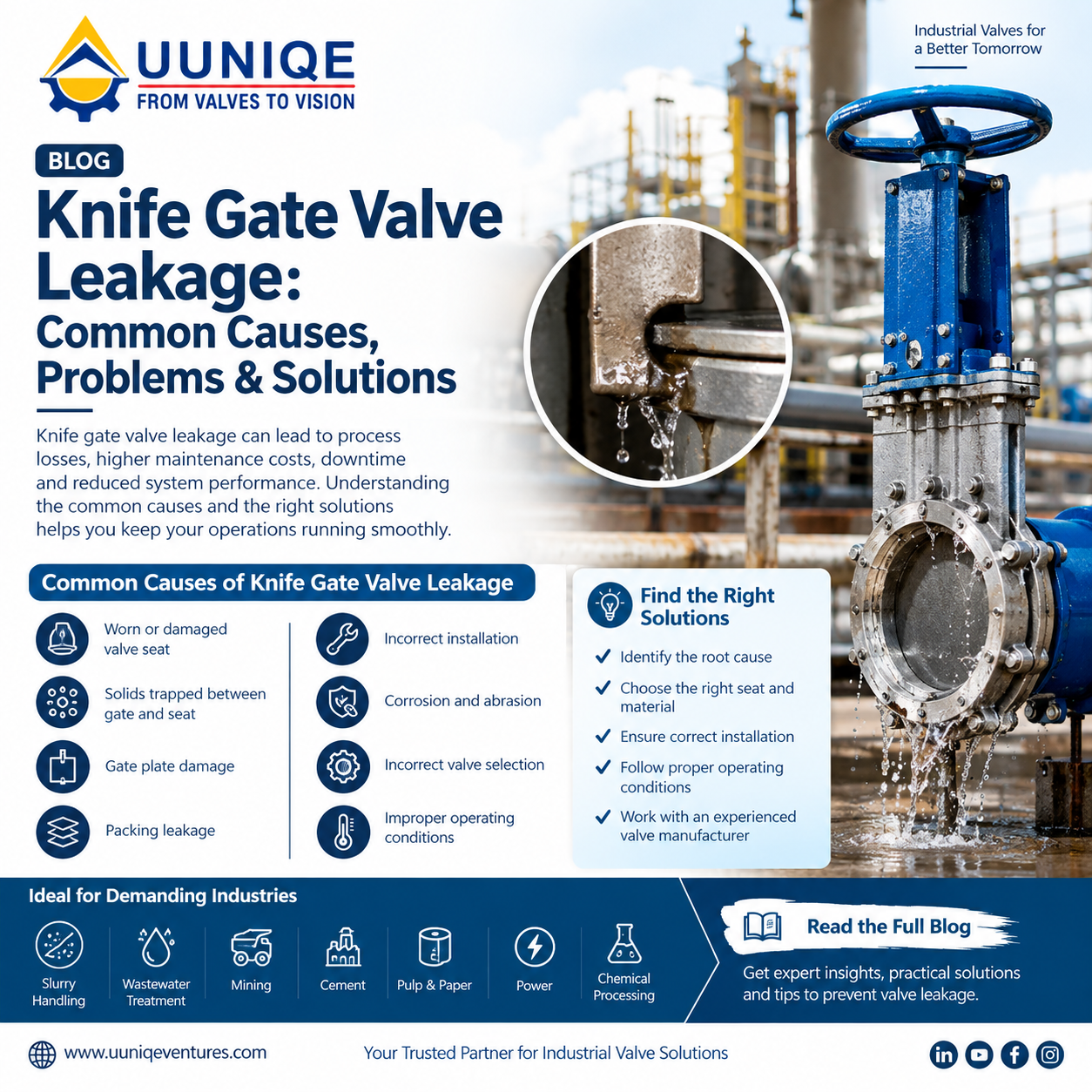
Knife gate valves are widely used in industrial systems where pipelines handle slurry, wastewater, sludge, pulp, powders, and other challenging media. They are designed mainly for isolation service, but leakage can still occur because of seat wear, packing problems, improper installation, abrasive media, or incorrect valve selection.
Understanding the actual cause of leakage is important before repairing or replacing a valve. In many cases, the problem can be prevented through proper valve selection, installation, and regular maintenance.
This guide explains the most common knife gate valve leakage causes, troubleshooting methods, maintenance practices, and solutions for industrial applications.
For demanding applications, choosing an experienced Knife Gate Valve Manufacturer in India can also help ensure that the valve design, materials, seat arrangement, and operating mechanism are suitable for the process.
Internal vs. External Knife Gate Valve Leakage- It is important to first identify whether the leakage is internal or external. Internal leakage occurs when fluid passes through the valve seat while the valve is in the closed position. External leakage occurs when fluid escapes to the atmosphere, commonly through the stem/packing area, body joint, or other external sealing points. Identifying the leakage location helps determine the appropriate inspection and corrective action
What Causes Knife Gate Valve Leakage?
Knife gate valve leakage can happen for several reasons. The most common causes include:
- Damaged or worn valve seat
- Solids trapped between the gate and seat
- Damaged gate plate
- Packing leakage
- Incorrect installation
- Corrosion and abrasion
- Incorrect valve selection
- High differential pressure
- Improper operation
- Lack of regular maintenance
The correct solution depends on where the leakage is occurring and the type of media handled by the valve.
1. Damaged or Worn Valve Seat
The valve seat plays an important role in achieving proper shut-off.
Continuous operation with abrasive slurry, chemicals, wastewater, suspended solids, or other difficult media can gradually wear the seating components.
A damaged or worn seat can cause:
- Internal leakage
- Poor shut-off
- Increased maintenance
- Process losses
- Difficulty closing the valve completely
If inspection shows significant seat damage, replacement may be required.
Seat design and retention are also important factors in sealing performance. The seat-support arrangement, seat compression, and method of retaining the seat should be suitable for the service. In slurry applications, the design should also consider the possibility of solids becoming trapped around the seating area.
The seat material should also be selected according to the actual application. Different industrial processes may require different sealing materials and designs.
2. Solids Trapped Between the Gate and Seat
One of the common causes of knife gate valve leakage is material getting trapped around the gate or sealing area.
This can happen particularly in applications involving:
- Slurry
- Wastewater
- Mining
- Cement
- Pulp and paper
- Biogas and waste handling
Although knife gate valves are suitable for many solid-containing applications, the valve design must still match the process conditions.
When solids prevent the gate from reaching its proper closed position, the valve may not achieve the required shut-off.
3. Damaged Gate Plate
The gate moves through the valve body during operation. In abrasive or corrosive services, the gate can gradually experience wear.
Possible problems include:
- Surface wear
- Scratches
- Corrosion
- Deformation
- Damage near the sealing area
A damaged gate may not provide proper sealing even when the valve is fully closed.
During maintenance, the gate should be checked for visible wear, corrosion, buildup, or mechanical damage.Gate alignment should also be checked. The gate should travel correctly through the seating area. Misalignment can create uneven contact between the gate and seat, resulting in localized wear and reduced sealing performance
4. Packing Leakage
Not every knife gate valve leakage problem is caused by the seat.
If fluid is escaping around the stem area, the packing may be the source of the problem.
Common causes include:
- Worn packing
- Incorrect packing adjustment
- Damaged stem
- Incorrect packing material
- Long operating periods
- Poor maintenance
Packing leakage should be inspected separately from leakage through the valve Seat.
If the packing has deteriorated, adjustment or replacement may be necessary. Gland compression should be controlled correctly. Insufficient compression can result in external packing leakage, while excessive compression can increase stem friction and operating torque
5. Incorrect Valve Installation
Incorrect installation can create problems even when the valve itself is properly manufactured.
Before installing a knife gate valve, check:
- Pipeline alignment
- Flange alignment
- Valve orientation
- Bolt tightening
- Pipeline support
- Available operating space
- Installation requirements
Misalignment can place additional stress on the valve body and sealing components.
Installation instructions provided by the Knife Gate Valve Manufacturer in India should be followed carefully.
6. Corrosion and Abrasion
Industrial valves can operate in harsh environments where corrosion and abrasion gradually affect components.
Abrasion is particularly important in applications involving:
- Mining slurry
- Cement
- Sand-containing fluids
- Pulp
- Wastewater with solids
- Other abrasive media
Corrosion can also affect the gate, body, stem, and other components depending on the process medium.
For this reason, material selection should always be based on the actual operating conditions.
7. Incorrect Valve Selection
Sometimes the valve is not defective at all. The problem may be that the selected valve is not suitable for the application.
Before selecting a knife gate valve, consider:
- Pipeline size
- Media type
- Solids concentration
- Particle size
- Abrasiveness
- Pressure
- Differential pressure
- Temperature
- Flow conditions
- Required shut-off
- Operating frequency
- Seat material
- Actuation requirements
An experienced Industrial Knife Gate Valve Supplier can help evaluate these factors before supplying the valve.
Knife Gate Valve Leakage in Slurry Applications
Slurry applications can be particularly demanding because the medium may contain abrasive solid particles.
Common issues include:
- Seat wear
- Gate wear
- Material buildup
- Packing wear
- Increased operating force
- Reduced sealing performance
When selecting a Knife Gate Valve Manufacturer and Supplier, it is important to explain the actual slurry conditions, including solids concentration, particle characteristics, pressure, temperature, and operating frequency.
A suitable valve should be selected based on the complete application rather than only the pipeline diameter.
UUNIQE Ventures Private Limited manufactures Knife Gate Valves for industrial applications involving slurry, solids, wastewater, and other demanding media.
Knife Gate Valve Leakage in Wastewater Applications
Wastewater systems can contain sludge, suspended solids, fibrous materials, and other contaminants.
If the valve does not close correctly, leakage may lead to:
- Uncontrolled flow
- Maintenance issues
- Process interruption
- Increased operating costs
For wastewater applications, valve construction and sealing arrangements should be selected according to the characteristics of the wastewater.
An experienced Industrial Knife Gate Valve Supplier can provide technical information to help determine the appropriate valve configuration.
How to Troubleshoot a Leaking Knife Gate Valve
If a knife gate valve is leaking, the following basic inspection process can help identify the possible cause.
Step 1: Identify the Location of Leakage
First determine whether the leakage is:
- Through the valve
- Around the stem
- Through the packing area
- Around the flange connection
This helps narrow down the possible cause.
Step 2: Check the Valve Position
Make sure the gate has moved completely to the required position.
A partially closed gate may not provide the required shut-off.
Step 3: Inspect the Gate and Seat
Look for:
- Wear
- Scratches
- Corrosion
- Material buildup
- Damage
- Deformation
Step 4: Inspect the Packing
If leakage is coming from the stem area, inspect the packing and stem condition.
Depending on the condition, the packing may need adjustment or replacement.
Step 5: Check Operating Conditions
Compare the actual pressure, temperature, media, and operating conditions with the valve’s intended service.
Step 6: Inspect the Valve Safely
Before maintenance, isolate and depressurize the relevant pipeline according to the plant’s safety procedures.
How to Prevent Knife Gate Valve Leakage
Preventive maintenance can help identify problems before they become major failures.
Recommended practices include:
- Inspect valves regularly
- Check for external leakage
- Inspect packing
- Check gate movement
- Remove excessive material buildup
- Monitor unusual operating resistance
- Inspect sealing components
- Check flange connections
- Maintain suitable operating conditions
- Replace worn components when required
Maintenance requirements will vary depending on the application and operating environment.
How to Choose the Right Knife Gate Valve Manufacturer
Choosing the right manufacturer is important for industrial valve applications.
Before purchasing, consider the following factors.
Manufacturing Capability
Check whether the manufacturer has the required manufacturing capability for the valve size, design, material, and configuration needed for your project.
Application Experience
A manufacturer should understand the actual application and operating conditions rather than supplying a valve based only on pipeline size.
Material and Seat Options
Different media require different materials and sealing arrangements. Ask the manufacturer about suitable options for your application.
Customization
Some industrial projects require special dimensions, materials, actuation, port configurations, or other modifications.
A Custom Knife Gate Valve Manufacturer can be useful when a standard valve does not meet the project’s requirements.
Quality Control
Check the manufacturer’s inspection and testing procedures before selecting valves for critical applications.
Export Capability
For international projects, experience with export packaging, documentation, logistics, and project requirements can be important.
Technical Support
Technical support during valve selection, installation, and maintenance can help reduce operational problems.
Custom Knife Gate Valves for Industrial Applications
Not every industrial pipeline can use the same standard valve configuration.
Depending on the project, customers may require:
- Special dimensions
- Different body materials
- Specific seat materials
- Special gate materials
- Customized actuation
- Special port configurations
- Private-label manufacturing
- OEM requirements
A Custom Knife Gate Valve Manufacturer can work with project requirements to develop a suitable valve configuration.
This is especially useful for EPC projects, OEM requirements, distributors, and industrial plants with application-specific requirements.
UUNIQE Ventures – Knife Gate Valve Manufacturer in India
UUNIQE Ventures Private Limited is an industrial valve manufacturer based in Indore, India. The company manufactures Knife Gate Valves, Slide Gate Valves, and Butterfly Valves for different industrial applications.
UUNIQE’s valve business was established in 2019, and UUNIQE Ventures Private Limited was incorporated in 2025.
Its Knife Gate Valve range includes uni-directional and bi-directional designs, with valve sizes available from 2″ to 24″ depending on the configuration and application.
The company has experience in industrial valve manufacturing and international supply, including the supply With more than 4,000 valves supplied since 2019, including supplies for international biogas applications
UUNIQE Ventures also supports private-label and customized industrial valve requirements, making it relevant for customers looking for a Custom Knife Gate Valve Manufacturer.
For buyers comparing the Best valve manufacturer in india, When evaluating valve manufacturers in India important factors should include manufacturing capability, application experience, technical support, customization, product range, and international supply experience—not simply the lowest purchase price.
Repair or Replace: What Should You Do?
Not every leaking valve needs complete replacement.
Repair may be suitable when:
- Packing is worn
- Seat is replaceable
- Minor components are damaged
- Operating components require maintenance
- Flange or connection issues are causing leakage
Replacement may be better when:
- The valve body is severely damaged
- The gate is badly worn
- Corrosion has significantly affected the valve
- The sealing system cannot be restored
- The valve is unsuitable for the actual application
- Repair costs approach the cost of a new valve
The final decision should be based on the valve condition, application requirements, and maintenance cost.
Frequently Asked Questions
1. Why is my knife gate valve leaking?
Common causes of knife gate valve leakage include a worn or damaged seat, solids trapped between the gate and seat, gate damage, packing problems, incorrect installation, corrosion, abrasion, or unsuitable operating conditions. A Knife Gate Valve Manufacturer in India can help identify the correct valve configuration for the application.
2. How do you stop a knife gate valve from leaking?
First identify where the leakage is coming from. Inspect the gate, seat, packing, flange connections, and operating conditions. Depending on the problem, adjustment, repair, component replacement, or complete valve replacement may be required.
3. How do I choose an Industrial Knife Gate Valve Supplier?
When selecting an Industrial Knife Gate Valve Supplier, consider manufacturing capability, valve size range, materials, seat options, application experience, quality control, customization capability, technical support, and international supply experience.
4. What should I look for in a Knife Gate Valve Manufacturer and Supplier?
A reliable Knife Gate Valve Manufacturer and Supplier should have suitable manufacturing capabilities, application knowledge, quality-control processes, technical support, customization options, and experience supplying valves for both domestic and international industrial projects.
5. Can knife gate valves be customized for industrial applications?
Yes. A Custom Knife Gate Valve Manufacturer can provide application-specific configurations such as special dimensions, materials, seat arrangements, actuation options, port configurations, and other project requirements.
6. Can knife gate valves be used for slurry?
Yes. Knife gate valves are commonly used for slurry and other solid-containing media. However, valve design, gate material, seat arrangement, pressure rating, and other specifications should be selected according to the actual slurry conditions.
7. How do I choose among the Best Valve Manufacturers in India?
When comparing the Best Valve Manufacturers in India, don’t consider price alone. Look at manufacturing experience, product range, application knowledge, customization, quality control, technical support, export capability, and previous industrial project experience.
8. What industries use knife gate valves?
Knife gate valves are used in applications such as wastewater treatment, mining, pulp and paper, cement, power, biogas, and other industries where the process may involve slurry, sludge, suspended solids, powders, or other challenging media.
9. When should I contact a Knife Gate Valve Manufacturer in India?
You should contact a Knife Gate Valve Manufacturer in India when you need help selecting the correct valve size, seat material, body material, actuation, pressure rating, or customized configuration for a specific industrial application.
10. Can UUNIQE Ventures supply customized knife gate valves?
Yes. UUNIQE Ventures Private Limited manufactures Knife Gate Valves and supports customized and private-label industrial valve requirements for different applications and project needs.
Conclusion
Knife gate valve leakage can result from many different factors, including seat wear, gate damage, packing problems, solids buildup, incorrect installation, corrosion, abrasion, and unsuitable valve selection.
Finding the actual cause before replacing the valve can help reduce unnecessary maintenance costs and prevent the same problem from occurring again.
For demanding industrial applications, working with an experienced Knife Gate Valve Manufacturer in India can help ensure that the valve design, materials, sealing system, and operating mechanism are appropriate for the application.
UUNIQE Ventures Private Limited provides Knife Gate Valves, Slide Gate Valves, and Butterfly Valves for industrial applications in India and international markets, including customized and private-label requirements.