
Knife Gate Valve Leakage: Common Causes, Problems & Solutions
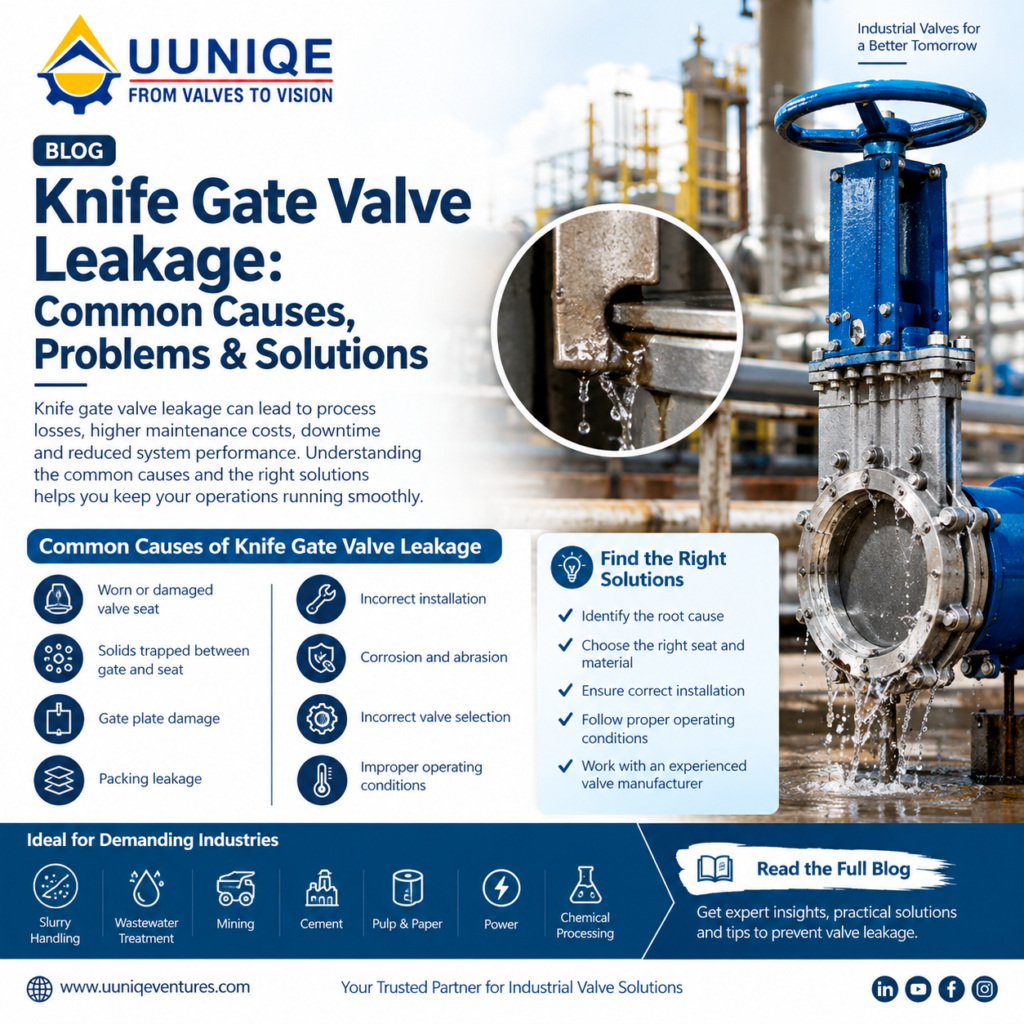
Knife gate valves are widely used in industrial systems where pipelines handle slurry, wastewater, sludge, pulp, powders, and other challenging media. They are designed mainly for isolation service, but leakage can still occur because of seat wear, packing problems, improper installation, abrasive media, or incorrect valve selection. Understanding the actual cause of leakage is important before repairing or replacing a valve. In many cases, the problem can be prevented through proper valve selection, installation, and regular maintenance. This guide explains the most common knife gate valve leakage causes, troubleshooting methods, maintenance practices, and solutions for industrial applications. For demanding applications, choosing an experienced Knife Gate Valve Manufacturer in India can also help ensure that the valve design, materials, seat arrangement, and operating mechanism are suitable for the process. Internal vs. External Knife Gate Valve Leakage- It is important to first identify whether the leakage is internal or external. Internal leakage occurs when fluid passes through the valve seat while the valve is in the closed position. External leakage occurs when fluid escapes to the atmosphere, commonly through the stem/packing area, body joint, or other external sealing points. Identifying the leakage location helps determine the appropriate inspection and corrective action What Causes Knife Gate Valve Leakage? Knife gate valve leakage can happen for several reasons. The most common causes include: Damaged or worn valve seat Solids trapped between the gate and seat Damaged gate plate Packing leakage Incorrect installation Corrosion and abrasion Incorrect valve selection High differential pressure Improper operation Lack of regular maintenance The correct solution depends on where the leakage is occurring and the type of media handled by the valve. 1. Damaged or Worn Valve Seat The valve seat plays an important role in achieving proper shut-off. Continuous operation with abrasive slurry, chemicals, wastewater, suspended solids, or other difficult media can gradually wear the seating components. A damaged or worn seat can cause: Internal leakage Poor shut-off Increased maintenance Process losses Difficulty closing the valve completely If inspection shows significant seat damage, replacement may be required. Seat design and retention are also important factors in sealing performance. The seat-support arrangement, seat compression, and method of retaining the seat should be suitable for the service. In slurry applications, the design should also consider the possibility of solids becoming trapped around the seating area. The seat material should also be selected according to the actual application. Different industrial processes may require different sealing materials and designs. 2. Solids Trapped Between the Gate and Seat One of the common causes of knife gate valve leakage is material getting trapped around the gate or sealing area. This can happen particularly in applications involving: Slurry Wastewater Mining Cement Pulp and paper Biogas and waste handling Although knife gate valves are suitable for many solid-containing applications, the valve design must still match the process conditions. When solids prevent the gate from reaching its proper closed position, the valve may not achieve the required shut-off. 3. Damaged Gate Plate The gate moves through the valve body during operation. In abrasive or corrosive services, the gate can gradually experience wear. Possible problems include: Surface wear Scratches Corrosion Deformation Damage near the sealing area A damaged gate may not provide proper sealing even when the valve is fully closed. During maintenance, the gate should be checked for visible wear, corrosion, buildup, or mechanical damage.Gate alignment should also be checked. The gate should travel correctly through the seating area. Misalignment can create uneven contact between the gate and seat, resulting in localized wear and reduced sealing performance 4. Packing Leakage Not every knife gate valve leakage problem is caused by the seat. If fluid is escaping around the stem area, the packing may be the source of the problem. Common causes include: Worn packing Incorrect packing adjustment Damaged stem Incorrect packing material Long operating periods Poor maintenance Packing leakage should be inspected separately from leakage through the valve Seat. If the packing has deteriorated, adjustment or replacement may be necessary. Gland compression should be controlled correctly. Insufficient compression can result in external packing leakage, while excessive compression can increase stem friction and operating torque 5. Incorrect Valve Installation Incorrect installation can create problems even when the valve itself is properly manufactured. Before installing a knife gate valve, check: Pipeline alignment Flange alignment Valve orientation Bolt tightening Pipeline support Available operating space Installation requirements Misalignment can place additional stress on the valve body and sealing components. Installation instructions provided by the Knife Gate Valve Manufacturer in India should be followed carefully. 6. Corrosion and Abrasion Industrial valves can operate in harsh environments where corrosion and abrasion gradually affect components. Abrasion is particularly important in applications involving: Mining slurry Cement Sand-containing fluids Pulp Wastewater with solids Other abrasive media Corrosion can also affect the gate, body, stem, and other components depending on the process medium. For this reason, material selection should always be based on the actual operating conditions. 7. Incorrect Valve Selection Sometimes the valve is not defective at all. The problem may be that the selected valve is not suitable for the application. Before selecting a knife gate valve, consider: Pipeline size Media type Solids concentration Particle size Abrasiveness Pressure Differential pressure Temperature Flow conditions Required shut-off Operating frequency Seat material Actuation requirements An experienced Industrial Knife Gate Valve Supplier can help evaluate these factors before supplying the valve. Knife Gate Valve Leakage in Slurry Applications Slurry applications can be particularly demanding because the medium may contain abrasive solid particles. Common issues include: Seat wear Gate wear Material buildup Packing wear Increased operating force Reduced sealing performance When selecting a Knife Gate Valve Manufacturer and Supplier, it is important to explain the actual slurry conditions, including solids concentration, particle characteristics, pressure, temperature, and operating frequency. A suitable valve should be selected based on the complete application rather than only the pipeline diameter. UUNIQE Ventures Private Limited manufactures Knife Gate Valves for industrial applications involving slurry, solids, wastewater, and other demanding media. Knife Gate Valve Leakage in Wastewater
How to Calculate Knife Gate Valve Size for Industrial & Municipal Piping Systems
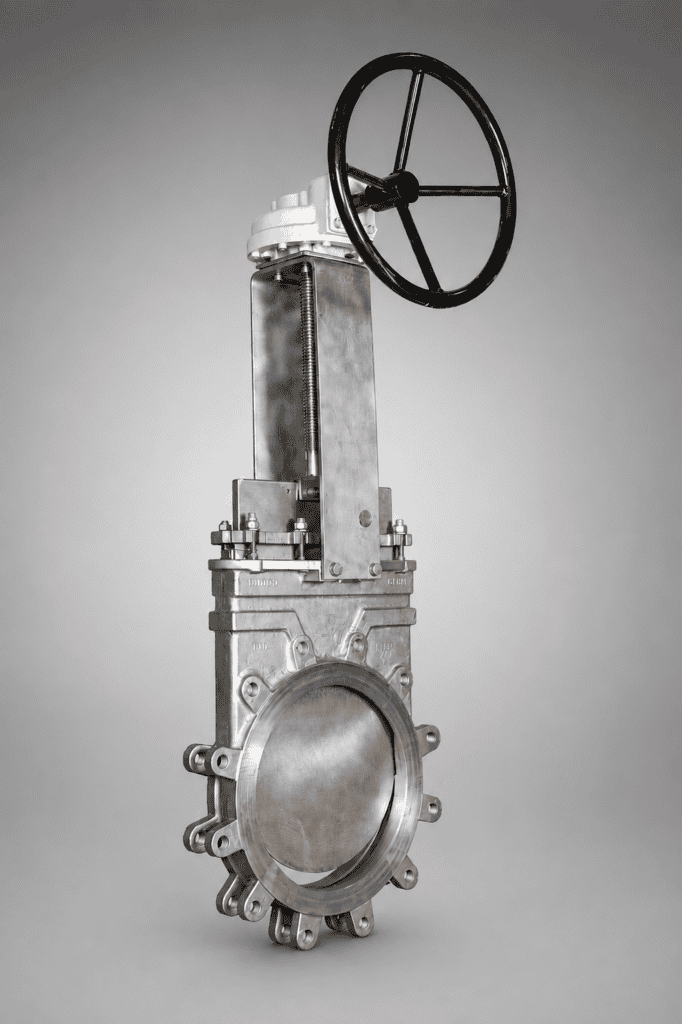
A practical guide to Knife Gate Valve sizing using flow rate, velocity, effective port area, pressure, differential pressure and application conditions. Selecting the correct valve size is an important part of designing and operating industrial and municipal piping systems, including water, wastewater, sewage, sludge, slurry, mining, pulp and paper, cement and other process applications. A valve that is too small may create excessive flow velocity and pressure loss, while an incorrectly selected valve may experience premature seat wear, difficult operation or inadequate shut-off performance. Simply selecting a Knife Gate Valve equal to the pipeline diameter without checking the application may also result in an unsuitable valve selection. A Knife Gate Valve Manufacturer in India should therefore consider more than nominal pipeline size when evaluating a valve requirement. Flow rate, actual flow passage, velocity, operating pressure, differential pressure, temperature, media characteristics, solids concentration, pressure rating, seat material and operating method can all influence the final selection. For most Knife Gate Valve isolation applications, the nominal valve size commonly matches the nominal pipeline size. However, the final selection should always be verified against the actual application requirements. What Is Knife Gate Valve Sizing? Knife Gate Valve sizing is the process of determining the appropriate valve size and configuration required to safely and reliably isolate or handle a fluid, slurry or solids-containing medium. Unlike many control valves, Knife Gate Valves are primarily used for isolation service. Therefore, preliminary sizing generally starts with pipeline size, flow rate, velocity and effective flow area, followed by pressure, media and mechanical verification. When evaluating products from Industrial Valve Manufacturers in India, buyers should understand that valve sizing is application-specific. The same nominal valve size can be used in different industries, but the required construction, seat, material and operating arrangement may vary. The objective is not simply to select a valve that fits the pipe, but to select a valve that fits the application. Key Parameters for Knife Gate Valve Sizing The following parameters should be considered during Knife Gate Valve sizing: Parameter What Needs to Be Checked Why It Matters Pipeline Size DN / NPS Establishes preliminary valve size Flow Rate Minimum / Normal / Maximum Determines flow capacity Flow Velocity Design / Actual Helps determine required flow area Effective Port Actual valve flow passage Used for actual velocity calculation Pressure Operating / Design Confirms pressure capability Differential Pressure P₁ − P₂ Important for operating force and actuator sizing Medium Water / wastewater / sludge / slurry Determines construction requirements Solids Concentration / particle size Important for sludge and slurry Temperature Normal / Maximum Influences seat and materials Seat EPDM / PTFE / NBR / FKM / Metal Determines sealing and compatibility Operation Manual / Pneumatic / Electric Determines operating requirements These parameters provide a practical starting point for valve sizing and selection. Why Correct Knife Gate Valve Sizing Matters Correct sizing helps achieve reliable operation while reducing unnecessary pressure loss, wear and maintenance. Undersized Valve Correctly Sized Valve Oversized Valve Higher flow velocity Appropriate velocity Unnecessary cost Higher pressure loss Required flow capacity Increased weight Possible increased wear Better service life Larger actuator may be required Higher operating force Reliable isolation More installation space Possible flow restriction Better overall performance May be economically inefficient For slurry, sludge, wastewater and abrasive applications, correct selection becomes even more important because solids and fluid properties can significantly influence wear, sealing performance and operating force. A Knife Gate Valve Manufacturer in India can use these application details to determine whether the preliminary valve size is suitable or whether additional engineering checks are required. Does a Knife Gate Valve Have to Be the Same Size as the Pipeline? For many isolation applications, the Knife Gate Valve is normally selected to match the nominal pipeline size. Pipeline Size Preliminary KGV Size Final Verification DN100 DN100 ✓ DN150 DN150 ✓ DN200 DN200 ✓ DN250 DN250 ✓ DN300 DN300 ✓ DN400 DN400 ✓ DN500 DN500 ✓ DN600 DN600 ✓ This should be treated as a starting point, not an automatic engineering rule. The selected valve should still be checked for: Flow rate Flow velocity Actual valve port Pressure rating Differential pressure Fluid characteristics Solids concentration Temperature Valve construction Seat arrangement Operating requirements The same approach should be followed when comparing Best Valve Manufacturers in India for a particular industrial application: nominal size is only one part of the overall selection process. Information Required Before Knife Gate Valve Sizing Before starting the sizing calculation, collect the required application information. 1. Pipeline & Hydraulic Data Important information includes: Pipeline DN/NPS Minimum flow Normal flow Maximum flow Design velocity Operating pressure Design pressure Differential pressure A Knife Gate Valve Manufacturer in India can use this information as the basis for preliminary hydraulic and mechanical evaluation. 2. Medium Information Identify exactly what will pass through the valve. Examples include: Raw water Treated water Wastewater Sewage Sludge Mineral slurry Cement-related process media Pulp Chemical process media For slurry and sludge applications, also consider solids concentration, density, viscosity, particle size and abrasiveness. 3. Temperature Provide both normal and maximum operating temperature. Temperature can influence: Valve body material Gate material Seat material Packing Sealing performance 4. Operating Method Specify whether the valve will be: Manually operated Gear operated Pneumatically operated Electrically operated Hydraulically operated The operating method affects the mechanical sizing and actuator requirements. How to Calculate Knife Gate Valve Size A practical Knife Gate Valve size calculation can be completed using the following steps. Step 1: Convert Flow Rate Convert the flow rate into m³/s. Q = Flow ÷ 3600 For example: 500 ÷ 3600 = 0.1389 m³/s Step 2: Calculate Required Flow Area Determine the required flow area using: A = Q ÷ V For: Q = 0.1389 m³/s V = 2.0 m/s Therefore: A = 0.1389 ÷ 2.0 A = 0.06945 m² Step 3: Calculate Equivalent Diameter Convert the required flow area into an equivalent diameter: D = √(4A/π) Using the example: D = √(4 × 0.06945 / π) D ≈ 297 mm Step 4: Select Preliminary
Best Valve Manufacturers in India (2026): Top Industrial Valve Companies Compared

Finding the Best Valve Manufacturers in India Finding the best valve manufacturers in India is an important decision for industries where reliable flow control and process isolation are essential. Industrial valves are used in cement plants, steel industries, mining, power generation, chemical processing, water treatment, pulp and paper, and many other manufacturing applications. However, choosing an industrial valve manufacturer should not be based only on the price quoted for a valve. The right manufacturer should understand the application, process media, pressure, temperature, valve size, material requirements, operating conditions, and maintenance requirements before recommending a suitable product. India has a growing industrial valve manufacturing sector with manufacturers and suppliers offering different types of valves for different applications. These include Knife Gate Valves, Butterfly Valves, Slide Gate Valves, Gate Valves, Ball Valves, Globe Valves, Check Valves, and application-specific flow-control solutions. In this guide, we explain how to compare valve manufacturers in India, what products and capabilities you should look for, which industries use different industrial valves, and what factors should be considered before selecting a valve manufacturer. What Makes the Best Valve Manufacturer in India? There is no single factor that makes a company the best valve manufacturer for every application. A manufacturer that is suitable for a water treatment project may not necessarily be the right choice for a cement plant or slurry-handling application. The best industrial valve manufacturer in India for your project should be able to provide a valve that matches your actual operating conditions. Before selecting a manufacturer, consider: Product range Manufacturing capability Material options Application experience Valve design Quality-control process Testing facilities Customization capability Technical support Spare-parts availability Delivery capability After-sales support A reliable manufacturer should be able to discuss your application and help you determine which valve configuration is appropriate. Types of Industrial Valves Offered by Manufacturers in India Different industrial processes require different types of valves. Understanding the basic applications of each valve can help you shortlist the right industrial valve manufacturer in India. 1. Knife Gate Valve A Knife Gate Valve is commonly used for applications involving slurry, suspended solids, powders, pulp, and other challenging media. The knife-shaped gate moves through the process media and provides shut-off when the valve is closed. Knife Gate Valves are commonly considered for: Cement plants Mining Slurry handling Pulp and paper Wastewater Chemical processing Ash handling Bulk material applications When looking for a Knife Gate Valve manufacturer in India, buyers should consider the valve’s material, size, pressure rating, sealing arrangement, operating mechanism, and application. 2. Butterfly Valve A Butterfly Valve uses a rotating disc to control or isolate flow. Its compact construction makes it useful for many industrial and utility applications. Butterfly Valves are commonly used in: Water treatment Wastewater treatment Industrial water systems Chemical processing Power plants HVAC systems General industrial pipelines When comparing Butterfly Valve manufacturers in India, look at available materials, sizes, pressure ratings, sealing options, actuation methods, and application experience. 3. Slide Gate Valve A Slide Gate Valve is generally used for isolating and controlling the movement of dry bulk materials. These valves can be useful in systems handling: Cement powder Fly ash Dust Granular materials Powdered materials Bulk solids For industries handling dry materials, selecting an experienced Slide Gate Valve manufacturer in India can help ensure that the valve design is suitable for the material-handling system. 4. Uni-Directional Knife Gate Valve A Uni-Directional Knife Gate Valve is designed for shut-off primarily in one flow direction. It can be considered for industrial applications where the flow direction is predetermined. Before selecting this valve, the manufacturer should evaluate: Flow direction Operating pressure Media Temperature Pipeline arrangement Sealing requirements 5. Bi-Directional Knife Gate Valve A Bi-Directional Knife Gate Valve is designed to provide shut-off in either direction under suitable operating conditions. This can make it useful for certain industrial pipeline configurations where flow direction may vary. The correct selection still depends on the actual process conditions and valve specifications. How to Compare the Best Valve Manufacturers in India When comparing valve manufacturers in India, don’t compare companies only on product price. Instead, compare their ability to provide the right technical solution. 1. Product Range A manufacturer with experience across relevant valve categories can be useful when a project requires multiple flow-control products. Check whether the manufacturer offers products such as: Knife Gate Valves Butterfly Valves Slide Gate Valves Uni-Directional Knife Gate Valves Bi-Directional Knife Gate Valves Fabricated Slide Gate Valves Rack & Pinion Slide Gate Valves 2. Manufacturing Capability Ask about the manufacturer’s ability to handle: Different valve sizes Different materials Different pressure requirements Manual operation Automated operation Application-specific configurations A strong manufacturing capability can be particularly important for industrial projects requiring customized solutions. 3. Quality Control Quality should be considered at every stage of manufacturing. A buyer should ask about: Raw material inspection Machining accuracy Assembly inspection Dimensional inspection Pressure testing Leakage testing Final product inspection The exact tests required depend on the valve type and applicable standards. 4. Application Experience This is one of the most important factors when selecting an industrial valve manufacturer. A manufacturer familiar with your industry may better understand the problems associated with your process. Cement plant: Dust, powder and abrasive materials can influence valve selection. Mining: Slurry and abrasive particles can place additional demands on valve components. Chemical industry: Corrosion and chemical compatibility can be critical. Water treatment: Flow isolation, corrosion resistance and system configuration may influence selection. 5. Customization Capability Industrial projects do not always work with a standard product. Depending on the application, buyers may require specific: Dimensions Materials Pressure ratings Connections Actuation Sealing arrangements Installation configurations Therefore, customization capability is an important factor when comparing industrial valve manufacturers in India. 6. Technical Support A good industrial valve supplier should be able to understand the customer’s application and provide technical guidance. Technical support can be useful for: Product selection Valve sizing Material selection Installation Operation Maintenance Spare parts Industrial Valve Manufacturers in India for Different Industries The right valve depends heavily on the industry and application.
Knife Gate Valve Working Principle: How Does a Knife Gate Valve Work?
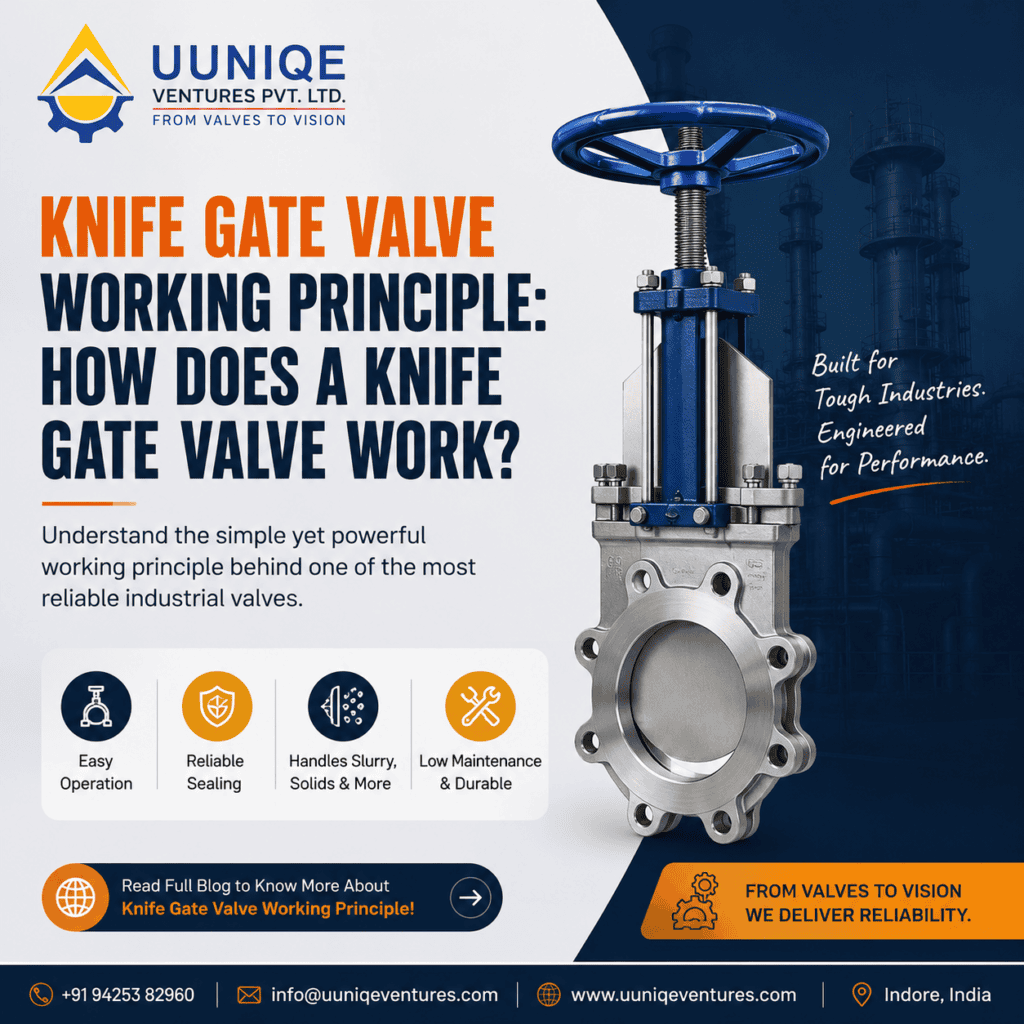
Industrial plants often handle materials that are difficult to control with ordinary valves. These materials may include slurry, pulp, thick liquids, solid particles, abrasive media, and other heavy process materials. For such applications, a knife gate valve can provide a practical solution for flow isolation. The Knife Gate Valve Working Principle is simple. A thin, sharp-edged gate moves up and down inside the valve body to open or close the flow passage. The gate can cut through slurry, solids, and thick material, making the valve suitable for demanding industrial applications. A good Knife Edge Gate Valve Manufacturer, Supplier in India understands that every application has different requirements. Valve size, body material, gate material, seat design, pressure, temperature, and process media all affect valve selection. Knife gate valves are widely used in water and wastewater treatment, paper and pulp, cement, power, chemical, mining, and other industrial sectors. They are mainly used for isolation and shut-off rather than precise flow regulation. In this guide, we will explain how a knife gate valve works, its main components, different types, applications, materials, advantages, maintenance requirements, and important points to consider before selecting a valve. What Is a Knife Gate Valve? A knife gate valve is an industrial isolation valve designed to start or stop the flow of process media. Unlike a traditional gate valve, a knife gate valve has a thin gate or blade. The edge of the gate is designed to move through the process material when the valve closes. This design makes knife gate valves useful for applications where the media contains: Solid particles Slurry Thick liquids Pulp Abrasive materials Other difficult industrial media When the gate is raised, the flow passage opens. When the gate moves downward, it blocks the passage and stops the flow. A professional Knife Edge Gate Valve Manufacturer, Supplier in India can provide different valve configurations depending on the application, including unidirectional and bidirectional designs. How Does a Knife Gate Valve Work? The basic Knife Gate Valve Working Principle is easy to understand. The valve contains a gate that moves vertically through the valve body. The gate is connected to a stem or operating mechanism. When the operator moves the stem, the gate moves upward or downward. When the Valve Is Open When the gate is completely raised, the flow passage becomes open. The process media can then move through the valve with minimal obstruction from the gate. When the Valve Is Closed When the gate moves downward, it enters the flow passage. The sharp edge helps the gate move through material that may contain solids, slurry, or thick media. Once the gate reaches the closed position, the seat provides the required sealing. This straightforward operation is one of the main reasons knife gate valves are used in heavy-duty industrial systems. Why Does a Knife Gate Valve Have a Sharp Edge? The sharp edge is an important part of the knife gate valve design. Imagine trying to push a thick piece of material with a flat plate. It would require significant force. A sharp edge can move through the material more easily. The same basic idea is used in a knife gate valve. The gate can move through difficult media and help close the flow passage. This feature is particularly useful when the pipeline carries slurry, pulp, solid particles, or other thick materials. However, the valve still needs to be selected correctly. Media characteristics, pressure, temperature, particle size, and abrasion can all affect valve performance. Main Components of a Knife Gate Valve Understanding the components makes the Knife Gate Valve Working Principle easier to understand. 1. Valve Body The body is the main outer structure of the valve. It holds the internal components and provides the connection between the valve and the pipeline. Depending on the application, the body can be manufactured from materials such as carbon steel, stainless steel, or other suitable materials. 2. Gate The gate is the main flow-control component. It moves vertically to open or close the passage. The gate is commonly manufactured from stainless steel or other materials selected according to the process conditions. For abrasive or corrosive applications, the gate material must be carefully selected. 3. Stem The stem transfers movement from the operating mechanism to the gate. When the operator turns the handwheel or activates an actuator, the stem moves the gate. A properly designed stem helps provide smooth and reliable operation. 4. Seat The seat creates the sealing area between the gate and the valve body. Knife gate valves can be supplied with different seat arrangements depending on the application. Common options include metal and resilient seat designs. 5. Operating Mechanism The operating mechanism controls the movement of the gate. Depending on the valve size and application, a knife gate valve may be operated manually or through an actuator. For automated systems, the valve can be integrated with suitable actuation equipment. Types of Knife Gate Valves Knife gate valves are available in different designs to meet different industrial requirements. Two important categories are unidirectional and bidirectional knife gate valves. Unidirectional Knife Gate Valve A unidirectional knife gate valve is designed primarily for flow in one direction. It is useful in systems where the flow direction is known and controlled. Different seat configurations can be selected according to the application. Metal Seated Type Metal seated knife gate valves are suitable for demanding applications involving high temperatures and abrasive materials. The metal seat provides a strong sealing arrangement for suitable industrial conditions. Resilient Seated Bend Type This design provides reliable sealing for general industrial applications. It can be selected when the process requires a resilient sealing arrangement. Resilient Seated Replaceable Retainer Ring Type The replaceable retainer ring design can make maintenance easier because the relevant seat components can be replaced when necessary. Resilient Seated Integral Seat Type This design provides a compact valve arrangement with strong sealing performance. The correct configuration should always be selected according to the actual process conditions. Bidirectional Knife Gate Valve A bidirectional knife gate valve
Butterfly Valve Working Principle: How Does an Industrial Butterfly Valve Work?
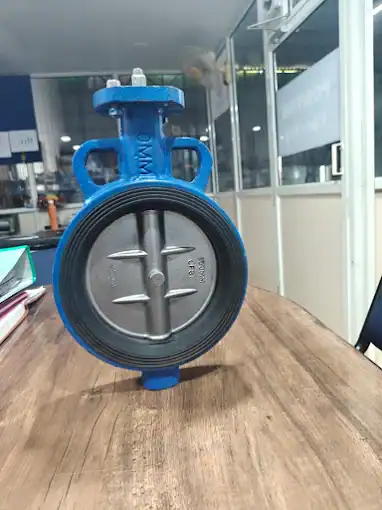
Butterfly valves are one of the most widely used flow control valves in modern industries. Their simple design, fast operation, and reliable performance make them an ideal choice for handling liquids, gases, steam, and other industrial media. From water treatment plants and chemical industries to power generation and cement manufacturing, butterfly valves play a critical role in ensuring smooth and efficient operations. Understanding the Butterfly Valve Working Principle is essential for engineers, plant operators, maintenance teams, procurement professionals, and anyone involved in industrial piping systems. Knowing how a butterfly valve works helps you choose the right valve, improve process efficiency, reduce maintenance costs, and increase the overall life of your piping system. Unlike many traditional valves, a butterfly valve operates with only a 90-degree rotation, making it one of the fastest and easiest valves to control. This quarter-turn operation allows industries to regulate or stop fluid flow quickly while requiring less operating effort. Today, industries prefer sourcing products from a trusted Butterfly Valve Manufacturer in Indore because of the growing reputation for quality engineering, reliable performance, and customized industrial solutions. Many buyers also work with a leading Butterfly Valve Manufacturer in India to ensure they receive durable valves that comply with international quality standards. In fact, many industrial buyers consider manufacturers from Indore among the best valve manufacturers in Indore because of their experience in manufacturing high-performance industrial valves for domestic and export markets. Choosing one of the best valve manufacturers in Indore helps industries achieve better product reliability, longer service life, and dependable technical support. This guide explains the Butterfly Valve Working Principle in simple language. It covers how butterfly valves work, their main components, different operating methods, and why they are one of the most preferred Industrial Butterfly Valve solutions for industrial flow control. What Is the Butterfly Valve Working Principle? The Butterfly Valve Working Principle is based on the rotation of a circular disc mounted inside the valve body. The disc acts as the main flow control element. As it rotates, it either allows fluid to pass through the pipeline or blocks the flow completely. A butterfly valve is known as a quarter-turn valve because it requires only a 90-degree rotation to move from the fully closed position to the fully open position. The operation is simple: When the disc is parallel to the flow direction, the valve is fully open. When the disc is partially rotated, the valve regulates the flow rate. When the disc becomes perpendicular to the flow direction, the valve completely stops the flow. This simple operating mechanism makes butterfly valves faster than many conventional valve designs. A high-quality Industrial Butterfly Valve is widely used because it provides excellent flow control while maintaining a compact and lightweight structure. These advantages make butterfly valves suitable for installations where space is limited and quick operation is required. Today, every reliable Butterfly Valve Manufacturer in India focuses on improving butterfly valve performance by using advanced materials, precision machining, and strict quality testing procedures. Similarly, the best valve manufacturers in Indore continue to develop butterfly valves that offer low operating torque, excellent sealing performance, and long service life for demanding industrial applications. How Does a Butterfly Valve Work? To understand how a butterfly valve works, imagine a circular metal disc placed inside a pipeline. This disc is connected to a shaft called the stem. The stem is attached to an operating mechanism such as a manual lever, gearbox, pneumatic actuator, or electric actuator. Whenever the handle is rotated or an actuator receives a control signal, the stem rotates the disc. The movement of the disc controls the flow inside the pipeline. Fully Open Position When the disc rotates parallel to the direction of the fluid, the valve allows almost unrestricted flow. In this position, pressure loss is minimal, making butterfly valves suitable for high-flow industrial systems. Partially Open Position The disc can stop at different angles between fully open and fully closed. This position allows operators to regulate flow instead of completely stopping it. The ability to throttle flow makes butterfly valves useful for many industrial processes. Fully Closed Position When the disc rotates by 90 degrees and becomes perpendicular to the flow, it completely blocks the passage. This creates a reliable shut-off and helps prevent unwanted flow through the pipeline. Modern butterfly valves manufactured by a trusted Butterfly Valve Manufacturer in Indore are designed to provide smooth operation even after thousands of opening and closing cycles. Industries looking for reliable flow control often choose products supplied by the best valve manufacturers in Indore because they deliver consistent quality, accurate machining, and dependable long-term performance. Main Components of a Butterfly Valve Every butterfly valve consists of several important components. Each part performs a specific function that contributes to smooth operation and long service life. Valve Body The valve body is the outer shell of the butterfly valve. It supports all internal components and connects the valve to the pipeline. Common body materials include: Cast Iron Ductile Iron Carbon Steel Stainless Steel Duplex Stainless Steel Special Alloy Materials The body material is selected according to pressure, temperature, and media compatibility. A reliable Butterfly Valve Manufacturer in India always recommends the correct body material based on the application. Valve Disc The disc is the primary flow control component inside the butterfly valve. It rotates during operation and controls the movement of the fluid. Common disc materials include: Stainless Steel Carbon Steel Aluminium Bronze Ductile Iron Duplex Stainless Steel The disc design directly affects valve efficiency, sealing performance, and pressure loss. High-quality Industrial Butterfly Valve manufacturers use precision-machined discs to improve flow performance and reduce wear. Stem The stem transfers movement from the operating mechanism to the valve disc. It is manufactured using high-strength materials to withstand continuous operation. A precision-machined stem ensures smooth rotation and long-term reliability. Valve Seat The valve seat creates a leak-tight seal between the disc and the valve body. Popular seat materials include: EPDM PTFE NBR Metal Seat Selecting the right seat material is
Butterfly Valve Manufacturer in Indore – Complete Guide to Butterfly Valve Types, Working, Applications & Advantages
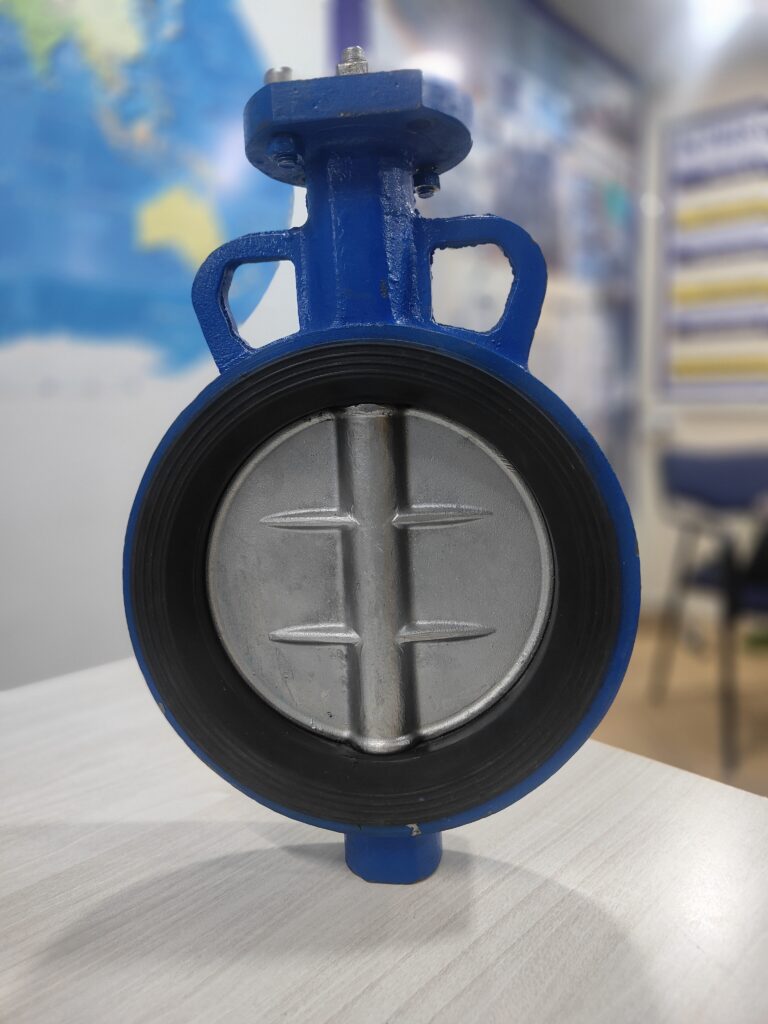
Butterfly valves play an important role in modern industrial piping systems. They are used to control, regulate, or stop the flow of liquids, gases, and other process media. Because of their compact design, quick operation, and reliable performance, butterfly valves have become one of the most popular flow control valves across different industries. Whether it is a water treatment plant, cement factory, chemical processing unit, power plant, steel manufacturing facility, or food processing industry, butterfly valves help maintain smooth and efficient operations. Their lightweight construction and quarter-turn operation make them easy to install, operate, and maintain. If you are searching for a trusted Butterfly Valve Manufacturer in Indore, it is also important to understand how butterfly valves work, the different types available, their applications, advantages, and how to choose the right valve for your industrial process. A better understanding helps engineers, buyers, EPC contractors, and plant operators select the right solution for long-term performance. India has become a leading manufacturing hub for industrial valves. Today, every reliable Butterfly Valve Manufacturer in India focuses on delivering high-quality products that meet national and international industrial standards. These valves are designed to provide efficient flow control while reducing maintenance costs and improving operational safety. This complete guide explains everything you need to know about industrial butterfly valves in simple language. Whether you are a beginner, engineering student, maintenance engineer, procurement manager, or industrial buyer, this article will help you understand butterfly valves from basic concepts to industrial applications. What Is a Butterfly Valve? A butterfly valve is a quarter-turn rotary valve used to start, stop, or regulate the flow of fluids inside a pipeline. The valve contains a circular disc mounted on a shaft. When the handle or actuator rotates the shaft by 90 degrees, the disc also rotates. When the disc is parallel to the direction of flow, the valve remains fully open and allows fluid to pass through the pipeline. When the disc rotates perpendicular to the flow, it blocks the passage and stops the movement of fluid. Because the valve requires only a quarter turn to open or close, it operates much faster than many traditional valve designs. A high-quality Industrial Butterfly Valve is widely preferred because it combines excellent performance with a compact and lightweight design. Compared to many other valve types, butterfly valves occupy less installation space and require fewer components, making them easier to maintain throughout their service life. Today, a professional Butterfly Valve Manufacturer in Indore produces butterfly valves in different materials, pressure ratings, and configurations to meet the needs of multiple industries. How Does a Butterfly Valve Work? The working principle of a butterfly valve is simple and highly efficient. Inside the valve body, a circular disc is connected to a central shaft called the stem. The stem is connected to a manual lever, gearbox, pneumatic actuator, or electric actuator. When the operator rotates the handle or when an actuator receives a control signal, the stem rotates. This movement turns the disc by 90 degrees. The valve operates in three different positions. Fully Open Position In the open position, the disc becomes parallel to the direction of flow. This allows liquid, gas, or slurry to move freely with very little resistance. Partially Open Position The disc can also remain partially open. In this position, the valve controls the flow rate rather than completely stopping it. This process is known as throttling. Fully Closed Position When the disc rotates perpendicular to the pipeline, it completely blocks the flow path. This creates a reliable shut-off for the system. The simple working mechanism is one of the biggest reasons why industries prefer butterfly valves over heavier valve designs in many applications. Leading companies working as a Butterfly Valve Manufacturer in India continuously improve valve design to provide smoother operation, lower torque, and longer service life. Main Components of a Butterfly Valve Every butterfly valve consists of several important components. Each part performs a specific function to ensure smooth and reliable operation. Valve Body The valve body forms the outer structure of the butterfly valve. It holds all internal components together and connects the valve to the pipeline. Depending on the application, the body can be manufactured using: Cast Iron Ductile Iron Carbon Steel Stainless Steel Special Alloys The body material should always be selected according to pressure, temperature, and media compatibility. Valve Disc The disc is the primary flow control component. It rotates inside the valve body to regulate fluid movement. Different disc materials are selected depending on the application. Common disc materials include: Stainless Steel Ductile Iron Carbon Steel Aluminium Bronze Duplex Stainless Steel A well-designed disc helps reduce pressure loss while improving sealing performance. Stem The stem connects the operating mechanism to the disc. It transfers rotational movement from the actuator or handle directly to the disc. High-strength stainless steel stems are commonly used because they provide excellent corrosion resistance and long service life. Seat The seat creates a tight seal between the disc and the valve body. A properly selected seat prevents leakage and improves valve efficiency. Different seat materials are available for different industrial applications, including: EPDM PTFE NBR Metal Seats The correct seat material depends on the process media, operating temperature, and pressure conditions. Actuator The actuator operates the butterfly valve. Different actuator options include: Manual Lever Gear Operated Pneumatic Actuator Electric Actuator Modern industrial automation systems often use pneumatic or electric actuators for remote operation. Why Are Butterfly Valves So Popular? Butterfly valves have become one of the most widely used industrial valves because they offer an excellent balance between performance, cost, and ease of operation. Some of the main reasons for their popularity include: Compact and lightweight design Quick quarter-turn operation Low installation cost Easy maintenance Reliable shut-off performance Suitable for manual and automated systems Available in a wide range of sizes and materials Excellent choice for water, chemicals, slurry, air, steam, and industrial fluids These advantages have made butterfly valves the preferred solution for thousands of industrial applications worldwide.
What Is a Knife Gate Valve? Complete Guide for Industrial Applications (2026)
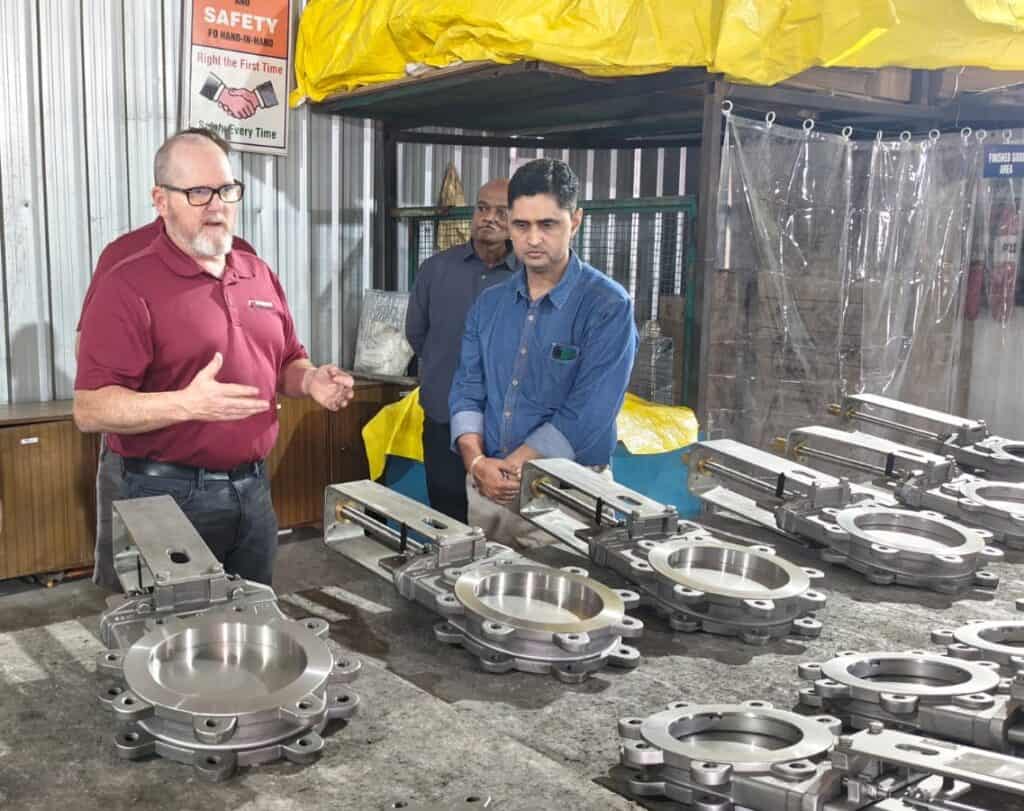
What Is a Knife Gate Valve? A Knife Gate Valve is a specially engineered industrial valve designed to isolate or control the flow of thick fluids, slurries, powders, wastewater, pulp, and other media containing solid particles. Unlike a conventional gate valve, a knife gate valve features a sharp-edged stainless steel gate that cuts through suspended solids and fibrous materials during operation. Because of its simple yet robust design, the knife gate valve is widely used in industries where traditional valves often fail due to clogging, abrasion, or excessive wear. Industries across India, the USA, Canada, Germany, France, Italy, and other European countries rely on knife gate valves for reliable shut-off in demanding process applications. Their ability to handle abrasive and viscous media makes them an ideal solution for modern industrial plants. As a trusted Knife Gate Valve Manufacturer in Indore, India, UUNIQE Ventures designs and manufactures precision-engineered valves that meet international quality standards for both domestic and export markets. How Does a Knife Gate Valve Work? The operating principle of a knife gate valve is straightforward yet highly effective. When the handwheel, gearbox, pneumatic actuator, or electric actuator is operated, the gate moves vertically inside the valve body. Valve Opening Process When the valve opens: The stainless steel blade moves upward. The flow passage becomes fully open. Fluids containing solids pass with minimal obstruction. Pressure loss remains low. Valve Closing Process When the valve closes: The sharpened gate moves downward. The blade cuts through slurry, fibers, or suspended solids. The seat forms a tight seal. Flow stops completely. This cutting action is the primary reason why knife gate valves outperform conventional gate valves in slurry and wastewater applications. Why Is It Called a Knife Gate Valve? The valve gets its name from the knife-shaped gate. Unlike ordinary gate valves that have a thick wedge-shaped gate, a knife gate valve has a thin, sharp-edged blade capable of cutting through: Sludge Paper pulp Mining slurry Fly ash Cement powder Wastewater solids Biomass Fibrous materials This unique design significantly reduces blockage and ensures smooth operation even in harsh industrial environments. Main Components of a Knife Gate Valve Every industrial knife gate valve consists of several precision-engineered components that work together to ensure reliable performance. 1. Valve Body The body is the primary pressure-containing component of the valve. Common body materials include: Cast Iron Ductile Iron Carbon Steel Stainless Steel (SS304) Stainless Steel (SS316) The body material is selected according to pressure, temperature, corrosion resistance, and application requirements. 2. Knife Gate (Blade) The blade is the heart of the valve. Its sharpened edge cuts through abrasive media during closing while providing complete shut-off. High-quality blades are usually manufactured from: SS304 SS316 Duplex Stainless Steel Hardened Stainless Steel 3. Seat The valve seat provides sealing between the blade and the valve body. Depending on the application, different seat materials are used: EPDM NBR PTFE Metal Seat The correct seat material greatly influences valve life and sealing performance. 4. Stem The stem transfers motion from the actuator or handwheel to the gate. It is generally manufactured using corrosion-resistant stainless steel to ensure long service life. 5. Gland Packing Packing prevents leakage around the stem while allowing smooth movement. Proper gland adjustment improves valve sealing and reduces maintenance costs. 6. Actuator Knife gate valves can be operated manually or automatically. Popular actuation options include: Handwheel Gearbox Pneumatic Actuator Electric Actuator Hydraulic Actuator Chain Wheel The actuator selection depends on plant automation requirements. Where Are Knife Gate Valves Used? Knife gate valves are widely used in industries where conventional valves struggle due to abrasive, corrosive, or solid-laden media. Water & Wastewater Treatment Wastewater treatment plants use knife gate valves to isolate sludge lines, clarifiers, and treatment systems. Their ability to handle suspended solids makes them an industry standard. Mining Industry Mining operations transport highly abrasive slurry containing minerals, sand, and rock particles. Knife gate valves provide reliable shut-off while minimizing wear. Paper & Pulp Industry Paper mills handle pulp, fibers, chemicals, and recycled materials. Knife gate valves prevent clogging and maintain uninterrupted production. Cement Plants Cement manufacturing involves powders, clinker dust, and fly ash. Knife gate valves control these difficult materials with excellent reliability. Power Plants Thermal and biomass power plants use knife gate valves for: Fly ash handling Bottom ash systems Slurry transportation Water treatment Chemical Processing Chemical industries require corrosion-resistant valves capable of handling aggressive fluids. Stainless steel knife gate valves are commonly selected for these applications. Steel Plants Steel manufacturing facilities use knife gate valves for: Cooling water Slag handling Dust collection systems Wastewater treatment Food & Biogas Plants Special hygienic knife gate valves are used in: Biogas plants Food processing Sugar industries Distilleries Why Are Knife Gate Valves Preferred for Slurry Applications? Slurry is one of the most challenging media to control because it contains a mixture of liquid and solid particles. Traditional valves often experience: Clogging Erosion Leakage High maintenance Frequent downtime Knife gate valves overcome these challenges due to their unique design. Key Benefits for Slurry Service ✔ Sharp blade cuts through solids. ✔ Full-port opening reduces clogging. ✔ Lower pressure drop. ✔ Handles abrasive materials efficiently. ✔ Easy maintenance. ✔ Longer service life. ✔ Lower operating costs. For industries such as mining, wastewater, cement, and paper processing, knife gate valves offer superior performance and reliability compared to many conventional valve designs. Why Global Industries Trust Indian Knife Gate Valve Manufacturers India has emerged as a major manufacturing hub for industrial valves, supplying high-quality products to customers worldwide. Manufacturers based in industrial cities such as Indore combine skilled engineering, modern production facilities, and competitive pricing to serve EPC contractors, OEMs, distributors, and end users across the USA, Canada, and Europe. At UUNIQE Ventures, we focus on delivering precision-engineered knife gate valves that meet international expectations for quality, durability, and performance. Every valve is designed with strict quality control and export-ready manufacturing practices to ensure dependable operation in demanding industrial environments. Advantages of a Knife Gate Valve A Knife Gate Valve
What Is a Butterfly Valve? A Complete Guide to Butterfly Valve Types, Working, Uses, Materials, and Maintenance
Butterfly valves are one of the most commonly used industrial valves in pipelines and flow control systems. They are simple, compact, easy to operate, and suitable for different industries. From water treatment plants to power stations, butterfly valves help control the movement of liquids, gases, and slurries. In this guide, you will learn what a butterfly valve is, how a butterfly valve works, butterfly valve types, applications, advantages, limitations, seat materials, maintenance, and installation methods in simple language. What Is a Butterfly Valve? A butterfly valve is a quarter-turn valve used to control or stop the flow of fluid in a pipeline. It works using a rotating disc mounted inside the valve body. When the disc rotates, it either allows or blocks the flow. The name “butterfly valve” comes from the butterfly-like movement of the disc during operation. Butterfly valves are popular because they are: Compact in design Lightweight Easy to install Fast in operation Cost-effective Suitable for large pipe sizes These valves are widely used for flow control and isolation in industrial systems. How Does a Butterfly Valve Work? The butterfly valve working principle is simple. A disc is placed inside the valve body and connected to a stem. When the handle, gearbox, pneumatic actuator, or electric actuator rotates the stem, the disc moves. Valve Closed Position When the disc is turned perpendicular to flow, it blocks the passage and stops fluid movement. Valve Open Position When the disc rotates parallel to flow, fluid moves freely through the pipeline. Since butterfly valves only require a 90-degree turn, they are called quarter-turn valves. This quick operation makes them suitable for industries where fast opening and closing are needed. Where Are Butterfly Valves Used? Butterfly valves are used in many industries because of their simple design and reliable performance. Water and Wastewater Industry Butterfly valves are widely used in water supply systems and wastewater treatment plants for flow regulation and isolation. HVAC Systems Heating, ventilation, and cooling systems use butterfly valves to manage water circulation and temperature control. Cement Industry Cement plants use butterfly valves for material handling, dust control, and process flow systems. Power Plants Power industries use butterfly valves to control steam, cooling water, and process systems. Chemical Industry Chemical plants use specially selected butterfly valves to handle chemicals safely. Oil and Gas Industry Butterfly valves help control fluids in pipelines and industrial systems. What Are the Advantages of Butterfly Valves? Butterfly valves provide many benefits in industrial applications. Compact Design These valves take less space compared to other valves. Lightweight Construction Butterfly valves are lighter, which makes handling and installation easier. Fast Operation Since they operate with a quarter-turn movement, opening and closing is quick. Cost-Effective Butterfly valves are affordable, especially for larger pipe sizes. Low Maintenance Their simple construction reduces maintenance requirements. Easy Automation Butterfly valves can easily work with electric or pneumatic actuators. What Are the Limitations of Butterfly Valves? Although butterfly valves offer many advantages, they also have some limitations. Not ideal for very high-pressure systems in some cases Disc remains inside flow path, causing slight pressure drop Some designs may not provide complete shutoff in extreme conditions Seat damage may happen due to improper operation Selecting the correct butterfly valve type helps avoid these problems. Butterfly Valve Types There are different butterfly valve types designed for specific applications. What Is a Wafer Type Butterfly Valve? A wafer type butterfly valve is installed between two flanges. It is one of the most compact and economical butterfly valve designs. Benefits Lightweight Cost-effective Easy installation Compact design Applications Water systems HVAC systems General industrial pipelines What Is a Lug Type Butterfly Valve? A lug type butterfly valve contains threaded inserts called lugs. These lugs allow easy installation and maintenance. Benefits Easy maintenance Strong mounting system Suitable for end-of-line service Applications Industrial pipelines Chemical plants Isolation systems What Is a Double Flanged Butterfly Valve? A double flanged butterfly valve contains flanges on both sides. This design provides strong support for larger pipelines. Benefits Strong installation Better alignment Suitable for heavy-duty systems What Is a Concentric Butterfly Valve? A concentric butterfly valve has a centered disc and seat arrangement. It is commonly used for low-pressure and general applications. Benefits Cost-effective Easy maintenance Reliable sealing Applications Water treatment HVAC systems What Is a Double Offset Butterfly Valve? Double offset butterfly valves use two offset positions to reduce friction. This design improves sealing and increases service life. Benefits Reduced seat wear Better sealing Suitable for higher temperatures What Is a Triple Offset Butterfly Valve? Triple offset butterfly valves are advanced butterfly valves designed for demanding applications. The disc movement reduces seat friction and improves sealing. Benefits Metal-to-metal sealing High temperature resistance Better performance in critical systems When Should Triple Offset Butterfly Valves Be Used? Triple offset butterfly valves should be used in: High-temperature systems High-pressure pipelines Steam systems Critical industrial applications Butterfly Valve Material & Seat Selection Choosing the right seat and material is important for valve performance. What Is EPDM Seat in Butterfly Valve? EPDM is a rubber seat material commonly used for water applications. Best For Water systems Wastewater systems Mild chemicals Advantages Good flexibility Affordable cost Long life What Is PTFE Seat in Butterfly Valve? PTFE seats provide excellent chemical resistance. Best For Chemical handling Corrosive fluids Advantages High chemical resistance Better durability What Is NBR Seat in Butterfly Valve? NBR is suitable for oil and petroleum-based applications. Best For Oil systems Fuel applications Which Butterfly Valve Seat Is Best for Chemicals? PTFE seats are usually considered best for chemical applications because they resist corrosion and aggressive chemicals. Which Butterfly Valve Seat Is Best for Water? EPDM seats are widely used in water and wastewater systems. Which Disc Material Is Best for Butterfly Valves? Common disc materials include: Stainless Steel Ductile Iron Carbon Steel Aluminum Bronze The best material depends on pressure, temperature, and media type. Cast Iron vs Ductile Iron Butterfly Valve Cast Iron Butterfly Valve Lower cost Suitable for general applications Ductile Iron Butterfly Valve
Customized Rack & Pinion Slide Gate Valve for Bagasse Application
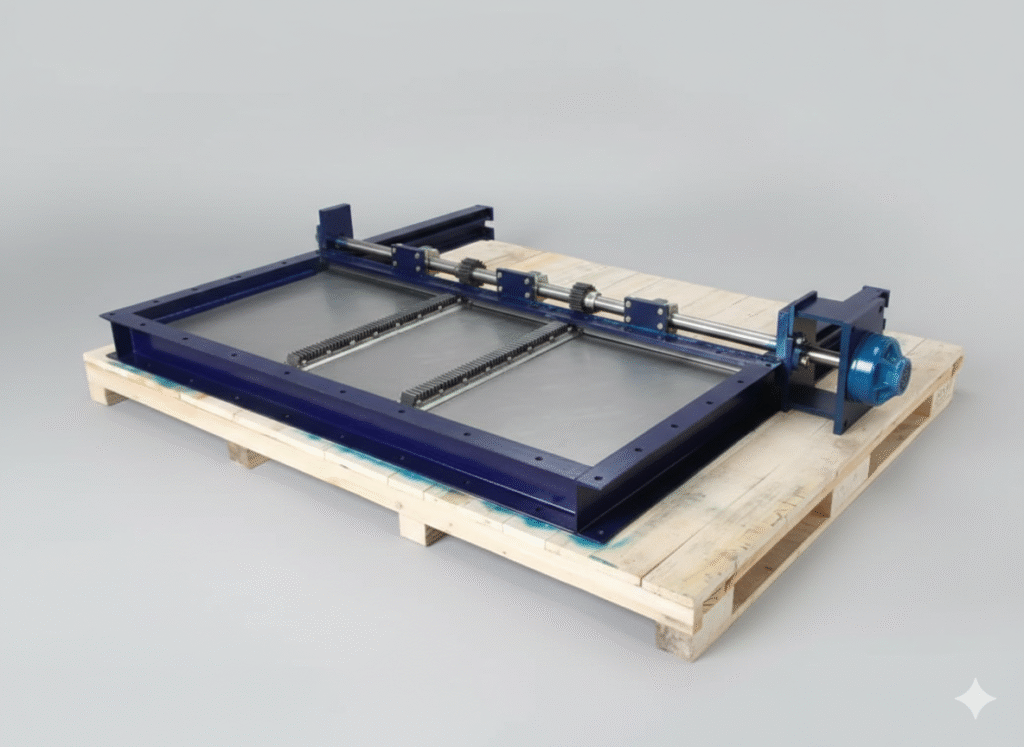
As a leading Slide Gate Valve Manufacturer in India, UUNIQE Ventures understands that industrial material handling systems often face critical space constraints. Standard equipment configurations do not always fit real-world site conditions, making custom-engineered solutions essential for successful project execution. At UUNIQE Ventures, we recently designed and supplied a 1900 × 800 mm customized Rack & Pinion Slide Gate Valve for a bagasse handling application in a sugar processing facility. The project required a non-standard approach due to severe space limitations that prevented the use of a conventional actuator arrangement. This case study demonstrates how innovative valve engineering can effectively overcome site constraints while ensuring operational efficiency, durability, and long-term reliability. Understanding the Application: Bagasse Handling Bagasse, a fibrous byproduct of sugarcane processing, presents unique handling challenges: Lightweight yet bulky material Tendency to clog and accumulate Requires controlled flow isolation Operates in dusty and abrasive environments Valves used in such applications must be: Robust and wear-resistant Capable of handling irregular material flow Designed for minimal maintenance The Project Challenge: Space Limitation for Actuator Mounting The client required a large slide gate valve for their bagasse conveying system. However, the installation site posed significant limitations: Key Constraints: Structural restrictions prevented installation of a top-mounted actuator Limited vertical clearance within the system layout Civil modifications would have increased project cost and timeline Standard valve configurations were not feasible for the available space These constraints created a high risk of project delays, increased costs, and operational inefficiencies. Our Engineering Solution Side-Mounted Rack & Pinion Slide Gate Valve To overcome these challenges, UUNIQE Ventures developed a customized Rack & Pinion Operated Slide Gate Valve with a side-mounted actuation system. This innovative design eliminated the need for vertical space while maintaining full operational efficiency. Key Design Features 1. Space-Optimized Side Mounting Actuator positioned on the side instead of the top Ideal for installations with restricted height clearance 2. Rack & Pinion Mechanism Converts rotational motion into smooth linear gate movement Ensures precise control and consistent operation 3. Heavy-Duty Construction Designed to withstand abrasive bagasse material Suitable for continuous industrial use 4. Compact and Accessible Design Easy access for inspection and maintenance Reduced downtime during servicing 5. Reliable Sealing Performance Effective isolation even in dusty and fibrous environments Technical Specifications Valve Type: Rack & Pinion Operated Slide Gate Valve Application: Bagasse Handling System Size: 1900 mm × 800 mm Actuator Mounting: Side-mounted (space-saving configuration) Operation: Manual / Motorized (customizable) Industries: Sugar Plants Biomass & Renewable Energy Plants Bulk Material Handling Systems Engineering Advantages of Rack & Pinion System Compared to conventional actuator systems, the rack & pinion mechanism offers: Better control over gate movement Reduced mechanical complexity in tight spaces Higher operational reliability Lower maintenance requirements Uniform force distribution across the gate Benefits Delivered to the Client By implementing this customized solution, the client achieved: ✅ No need for civil or structural modifications ✅ Faster installation and commissioning ✅ Optimized use of available space ✅ Reliable heavy-duty performance ✅ Reduced overall project cost ✅ Improved operational efficiency Why Customized Slide Gate Valves Matter Every industrial facility operates under unique conditions, including: Limited installation space Specific process flow requirements Material characteristics (abrasive, fibrous, or granular) Load variations and operating cycles Standard valve designs often fail to meet these requirements. This is where custom-engineered slide gate valves provide significant value by: Enhancing system efficiency Reducing downtime Improving safety and reliability Ensuring long-term performance Industries That Benefit from Custom Solutions UUNIQE Ventures provides customized valve solutions for: Sugar Industry Biomass & Renewable Energy Power Generation Plants Cement & Mining Industry Bulk Material Handling Systems Partner with UUNIQE Ventures for Smart Valve Engineering – If your project faces space limitations, high load requirements, or non-standard applications, our engineering team can deliver reliable, tailor-made valve solutions. Conclusion This project highlights how practical engineering combined with innovation can solve complex industrial challenges. The customized Rack & Pinion Slide Gate Valve not only addressed the space constraint issue but also improved the overall efficiency and reliability of the system. At UUNIQE Ventures, we go beyond standard manufacturing we deliver engineering-driven solutions tailored to real-world applications.
Export Case Study: 4,000+ Knife Gate Valves Supplied to the U.S. Biogas Industry
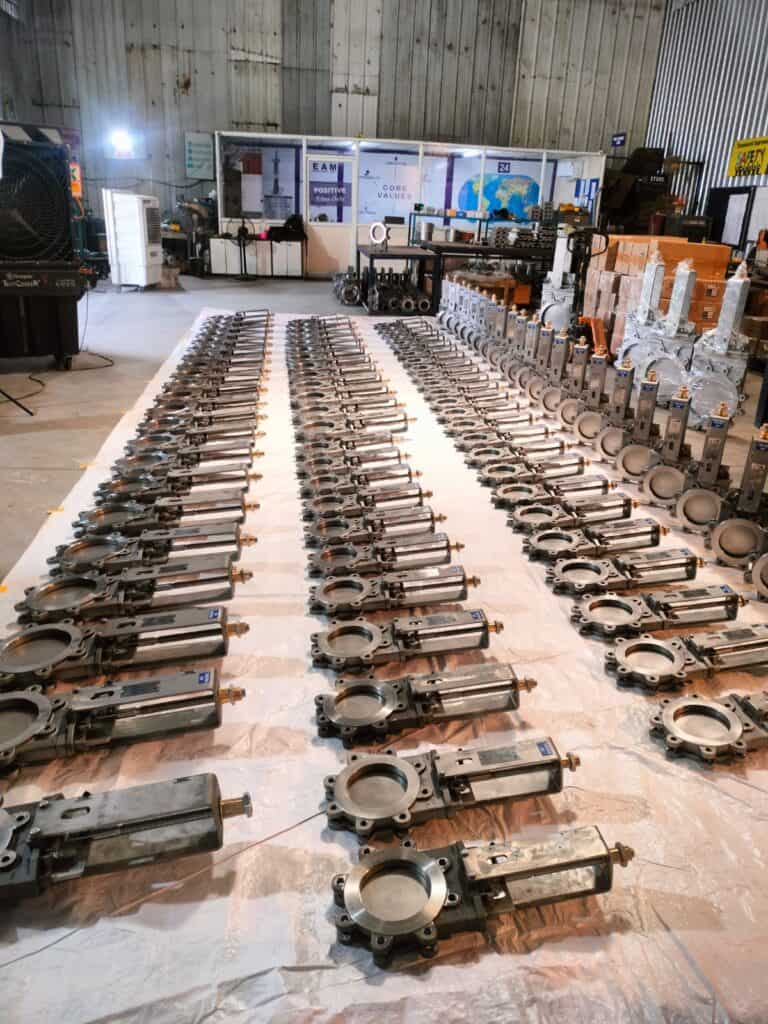
Since 2019, UUNIQE Ventures has successfully supplied more than 4,000 Knife Gate Valves to a U.S.-based company operating in the biogas and renewable energy sector. This long-term private label (OEM) partnership reflects our capability as a reliable industrial valve manufacturer and exporter. Over six years, we consistently delivered: High product quality On-time shipments Accurate export documentation Full support for client branding This case study highlights how we built a strong and sustainable export partnership in the competitive U.S. market. About the Client and Industry The client is a distributor and stockist serving the U.S. biogas industry, where maintaining ready inventory and fast delivery is critical. Industry Challenges In this sector: Delays can lead to lost projects Product failure can damage brand reputation Client Requirements The client was looking for a dependable Knife Gate Valve manufacturer who could: Supply valves under private label (OEM model) Maintain strict quality and testing standards Ensure reliable delivery timelines Provide accurate export documentation Match the performance of established global brands After sample approval and technical finalization, the partnership began in 2019. Scope of Supply Over the course of this partnership, we supplied: Product Specifications Total Valves: 4,000+ units Valve Type: Knife Gate Valves Size Range: 2” to 24” Pressure Rating: PN10 Material: Stainless Steel SS304 (CF8) Application: Biogas and renewable energy Supply Model: Private Label / OEM All valves were tested as per MSS SP-81 standards and client-specific requirements. Key Challenges in Export Supply As a growing export-focused manufacturer, we managed several critical challenges: 1. Delivery Reliability Maintaining strict timelines to support client inventory in the U.S. 2. Production Planning Managing multiple sizes, including large 24” valves. 3. Quality Control Ensuring proper inspection and hydro testing for every valve. 4. Custom Design Requirements Implementing minor design changes as per international standards. 5. Documentation & Traceability Maintaining batch-wise records for full traceability. 6. Export Packaging Using export-grade materials with clear labeling. 7. Development of Dies and Patterns Creating casting dies and patterns especially for larger sizes based on confirmed orders. Since the valves were supplied under the client’s brand, maintaining precision and consistency was critical. Client Concerns and Risk Factors Before starting the partnership, the client highlighted key risks: On-time delivery performance Authenticity of SS304 (CF8) material Leakage performance of metal seated valves Performance comparison with global brands Accuracy of export documentation Strong packaging to prevent transit damage In private label supply, any failure directly affects the distributor’s brand. Therefore, trust in our processes was essential. Solutions Implemented To address these requirements, UUNIQE Ventures implemented a structured approach: In-House Machining and Assembly Ensured dimensional accuracy and consistency. Reliable Foundry Network Enabled consistent casting quality up to 14” sizes using investment casting. Alternate Machining Support Handled bulk and urgent orders efficiently. Structured Quality Inspection Multiple inspection stages during manufacturing. Hydro Testing Each valve tested as per MSS SP-81 standards. Documentation and Traceability Maintained detailed batch records and reports. Export Packaging and Compliance Used strong wooden boxes and ensured smooth customs clearance. Spares and Interchangeability Designed components for easy maintenance and replacement. Results Achieved Over six years, this partnership delivered strong results: Key Outcomes 4,000+ valves exported Continuous repeat orders Stock availability for fast-moving sizes Minimal performance complaints Capability Development Complete development of dies and casting patterns (2” to 24”) Successful development of Bi-Directional (U-Seal) Knife Gate Valves up to 24” Field-proven performance Investment casting capability up to 14” These advancements significantly strengthened our manufacturing capabilities. Conclusion Supplying 4,000+ valves is not just a milestone it represents: Long-term delivery reliability Strong quality control systems Compliance with international standards Effective private label manufacturing Continuous capability development UUNIQE Ventures continues to support distributors, EPC contractors, and renewable energy companies with dependable valve solutions. At UUNIQE Ventures, we don’t just manufacture valves we help build brands behind the brands. Confidentiality Statement Due to private label agreements and confidentiality commitments, specific client names and project details cannot be disclosed.
